



Introduction
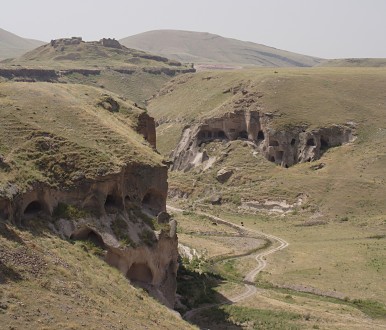
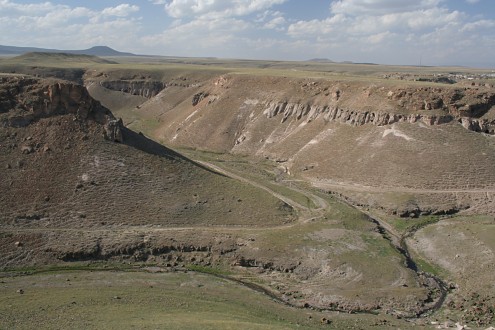
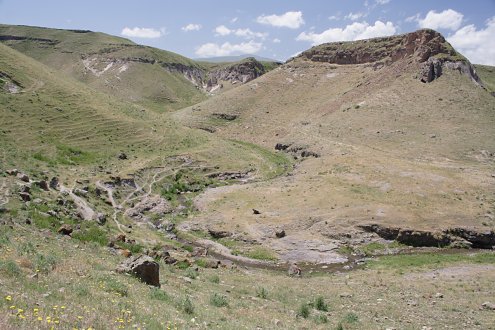
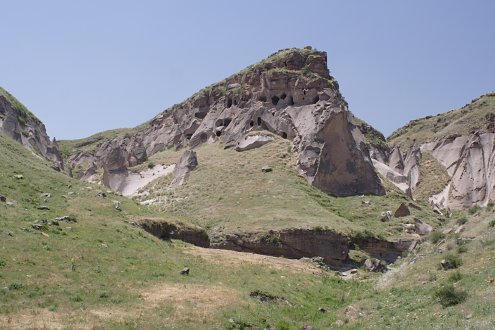
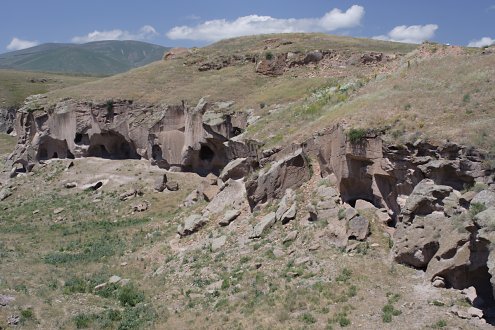
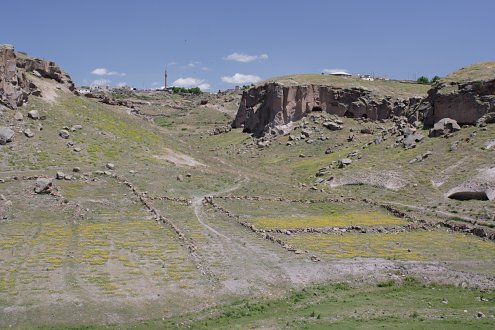
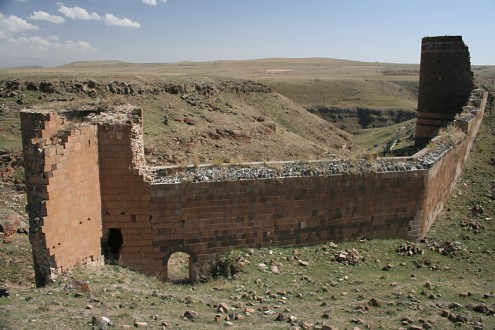
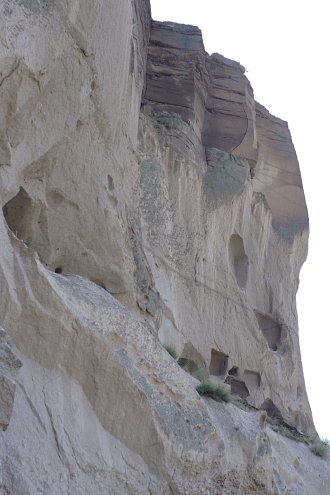
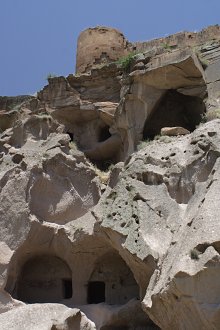
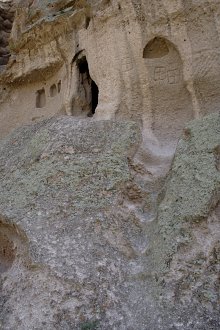
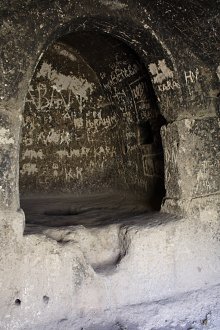
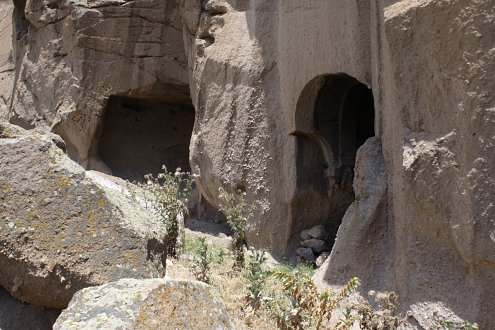
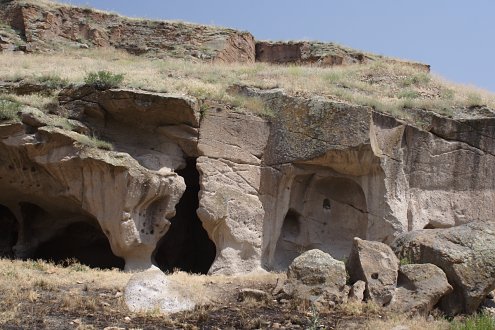
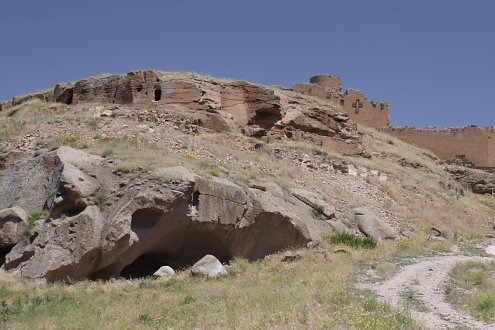
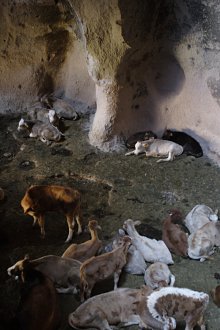
Ani sits on a triangular-shaped site that is bordered by deep canyons which isolate it from the surrounding land. These canyons, created by the actions of the streams and rivers that flow through them and (probably) also by geological movements, cut through multiple layers of rock of volcanic origin. These layers are of varying thickness throughout the site, and alternate between harder and softer consistency. Generally, the highest levels tend to be composed of harder layers of reddish-coloured volcanic tufa, and the lower levels tend to be made up of softer layers composed mostly of grey-coloured compressed volcanic ash that is often rich in obsidian fragments. The softer layers are very easy to excavate into, and large numbers of rock-cut chambers can be found throughout the cliffs that surround Ani. The caves have been subjected to a longer period of use than Ani. Some of them were still being lived in at the start of the 20th century [note 1], and many are still used for storage purposes or as pens for cows or sheep. Underground chambers also exist within the walled area of Ani, but this page will deal only with those that are located outside the city walls.
The first systematic investigation of the rock-cut chambers at Ani was done in 1915 by David Kipshize, a member of Nikolai Marr's team excavating Ani. He identified, explored, and classified more than 800 chambers, produced an overall map, numerous plans, and made panoramic photographs of the canyon walls that were annotated to show the location of specific rock-cut complexes. His results were not published - wartime conditions were soon to stop all work at Ani, and Kipshize died in Tiflis in 1919.
Much later, Nikolai Tokarski (who had also worked at Ani with Marr and Kipshize) collected and re-organised Kipshize's notes and, adding some other findings and materials, published the results in 1972 as the book "Caves of Ani" [note 2].
In 2004, a team of Italian researchers headed by Roberto Bixio revisited Kipshize's work by undertaking a new survey of selected parts of the cave systems. Their results were published in 2009 as the book "Ani 2004: Surveys on the Underground Settlements" [note 3]. This 2004 investigation discovered that though the Kipshize maps and plans show an overall agreement with reality, there was a substantial deviation from reality in the details. They concluded that Kipshize's surveys had been performed in a quick way, resulting in serious imprecision in relation to the layout of individual cave structures. The Italians produced new plans and section drawings of several of the cave complexes surveyed by Kipshize. The plan below left is from the 2004 survey with, on the right, Kipshize's 1915 survey of the same cave complex.

As the above example shows, Kipshize's plans made the rock-cut complexes appear more regular, better planned, and better executed than they were in reality. This inaccuracy gave to the chambers an exaggerated level of sophistication, contributing to the myth that there was an actual "underground city" district at Ani. Some of the rock-cut complexes are large and well planned, and in that sense they do parallel the city above and would have functioned alongside it - as would have the tunnel, the so-called "Secret Gates", that runs from the base of the Tsaghkotsadzor up into the city. However, the majority of the chambers are small, isolated, scattered, and very irregular in layout, with many of them probably built to serve the countryside rather than to act as a suburb of Ani.
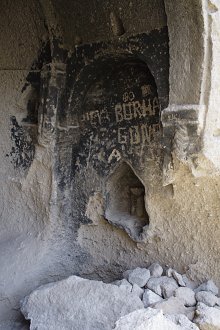
The 2004 researchers stated that the caves were substantially unchanged from Kipshize's time. I disagree with that conclusion. There is visible recent destruction in many of the rock-cut complexes, perhaps caused by the 1935 earthquake, perhaps by the 1988 earthquake. To identify the caves, the Russian investigators marked them using letters or numbers in black paint, sometimes inside a black circle. You can see an example of this in the large version of photograph 27: "No.8" is written on the inner wall [note 4]. In some instances these markings now lie at odd angles, or are on fragments that are now completely separated from the cave structure they were attached to in Kipshize's time.
The location of the rock-cut chambers
There are man-made caves in all the canyons and valleys that surround Ani. On the western side of Ani is the Tsaghkotsadzor canyon, also known as the Bostanlar Deresi and the Aladja (Alaca çay). On the northwestern side of Ani is a branch valley of the Tsaghkotsadzor, the Igadzor valley. The Tsaghkotsadzor has other branch valleys that also have caves: the largest one on its western side is called the Bagnayridzor, and on its eastern side, north of the Igadzor, is the Anidzor, located below the village of Ani (Ocakli). On the eastern side of Ani is the deep canyon of the river Akhurian (Arpaçay), and on the northeastern side of Ani is a branch valley, the Gayledzor (also known as the Mirmir or Tatarcık Deresi).
The branch valleys are mostly dry on the surface except in times of heavy rain, but a small stream, known as the Ani River, meanders through the Tsaghkotsadzor canyon. The great majority of the caves are found in the Tsaghkotsadzor canyon. Kipshize divided the locations of the caves into 30 sections; 22 of them lay in the Tsaghkotsadzor and its tributaries.
The functions of the rock-cut chambers
Many of the chambers had clearly defined functions. For others, the intended original use is less clear or is completely unknown. Erosion and collapses over the centuries have destroyed large parts of some of the cave complexes, often leaving the surviving parts fragmentary and confusing. Kipshize / Tokarski estimated that the rock-cut area of Ani might have had some 2000 inhabitants at its peak.
Religious uses
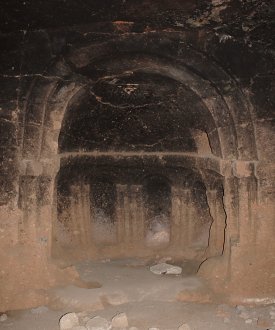
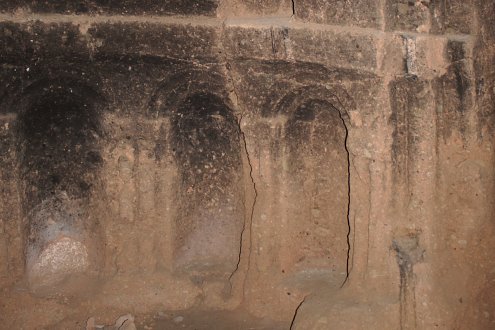
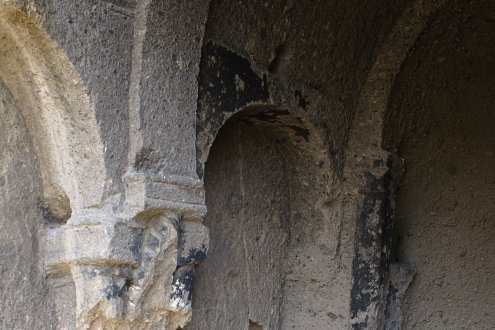
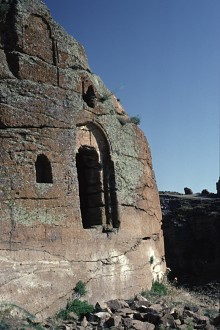
A number of the rock-cut chambers are small churches or chapels – Kipshize counted 30 of them, some part of larger complexes, possibly monastic in function. The architecture of the rock-cut churches generally follows the typology of built architecture, not only in the overall layout but in the details, such as reproducing the v-shaped niches, the colonnettes, and the capitals found in the freestanding churches of the city above.
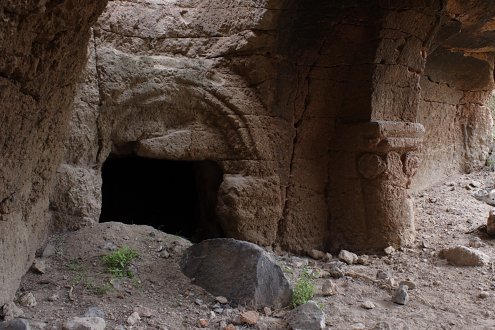
One of the largest rock-cut churches is in the Gayledzor valley [see photographs 10 to 13]. The plan below is by Toros Toramanian (with some alterations and additions) - however, like Kipshize's plans, it makes the design appear more regular and better executed than it actually is.
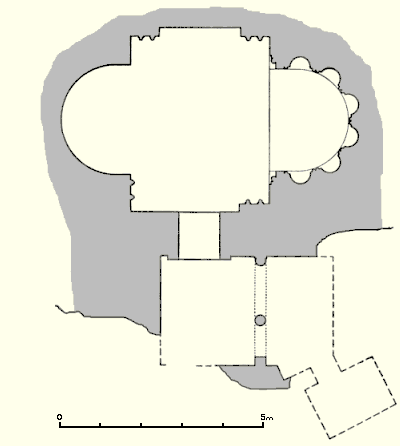
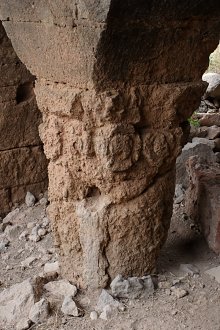
In Kipshize/Tokarski this church is named chamber A/20; however, this seems to be an error - the "A" prefix is only for chambers in the Igadzor, "B" is for those in the Gayledzor. It has a rectangular nave with large semicircular apses on the east and west sides. The length of the church, from the end of one apse to the end of the other, is about seven metres. The eastern apse has six niches, reminiscent of the niches in the apse of the cathedral, as well as other architectural features derived from stone-built churches. The ceiling, however, is almost flat. The church is preceded by a rock-cut narthex that has a freestanding column hewn out of the living rock.
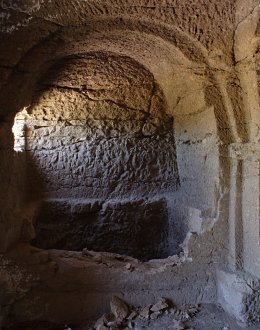
A small chapel (Kipshize: F/13) in the Anidzor valley [see photographs 14 to 16] has an apse that is raised substantially above the floor level, a degree of separation that suggests regular public access to the chapel despite its small size. It has v-shaped niches in its north and south walls that one would have expected to see on the external walls of a freestanding church. Below is its plan, and a section.

Another church (Kipshize: F/20) nearby [see photographs 17 to 20] has a barrel vault and pilasters of clustered colonnettes with zigzag decoration. A small church in the Igadzor valley seem to consist of only an apse [see photograph 21], suggesting it either originally had a nave constructed of cut stone or of timber, or it was an open-to-the-air sanctuary.
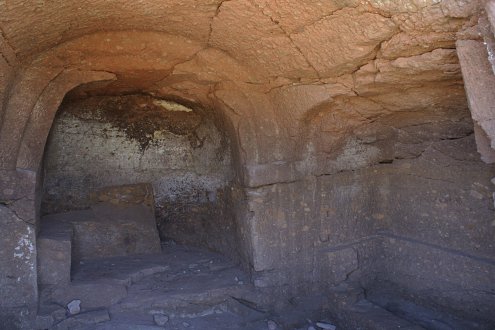
Others caves had a funerary purpose, with grave chambers incised into their floors. The extensive sepulchral complex containing the frescoed chamber known as the tomb of Tigran Honents is the most sophisticated example (this site will be covered on a separate page). The best smaller-scale examples are the two chambers (Kipshize: A/1 and A/2) with stone sarcophagi, said in some sources to have been royal tombs, that are located side by side at the head of the Igadzor valley and close to the city walls [see photographs 22 to 25]. Below is a plan of each of them (by Tokarski).
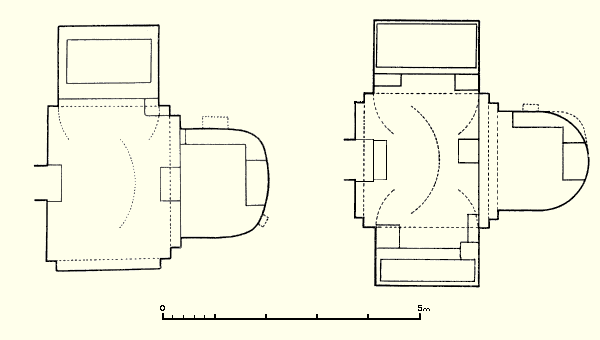
The tombs each have an entrance on the west side and a church-like eastern apse containing an altar hewn from the rock. Both altars have extensions that curve around the north side of the apse; at a glance, these extensions might appear to be just unfinished work - stone that was intended to be removed but for some reason wasn't. However, the fact that the same form occurs inside both tombs indicates a specific purpose. There are sarcophagi hewn from the living rock on the north and south sides of the northernmost tomb, and on the north side of the southernmost tomb. The sarcophagi are inside barrel-vaulted recesses that could be seen as the equivalent of the arms of a church, or as arcosolium recesses. There is a rim around the top of each sarcophagus, suggesting a stone slab had originally covered the opening. A significant detail omitted from Tokarski's plan is that the north recess of each tomb is illuminated by a small window. The south recess in the northern tomb has no window, and is cruder in its execution, suggesting that it may be a later addition.
Economic uses
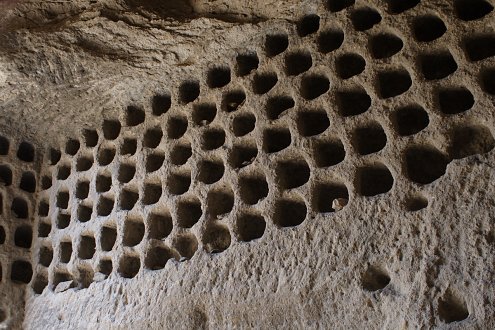
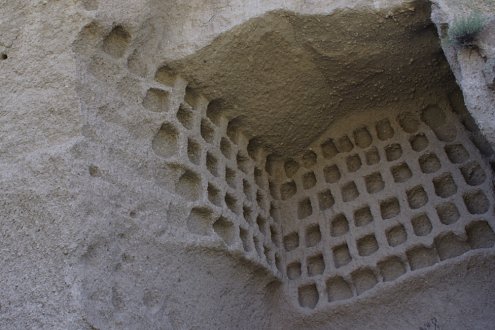
The most unambiguous function is that of dovecotes. These usually contain many rows of densely-packed rectangular cubicles for pigeons. Most are housed in rectangular chambers [see photographs 26 and 27], but one is circular. Kipshize says that there were 16 such pigeon houses, scattered throughout all the sectors. Bixio speculates that some of them may have actually been for bees (apiaries).
There were also chambers intended for water storage, cellars for storage of wine and oil jars, stables, and a large chamber that has been identified as a caravanserai. As mentioned earlier, a number of caves, especially those located close to Ani village, are still used for storage or for housing farm animals [see photograph 28].
Domestic dwellings
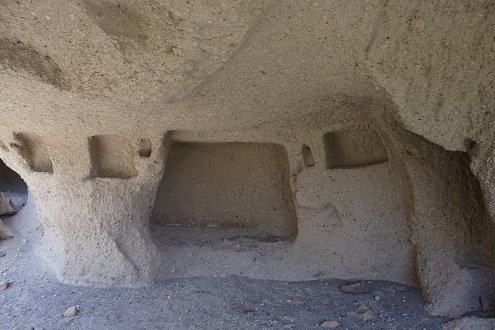
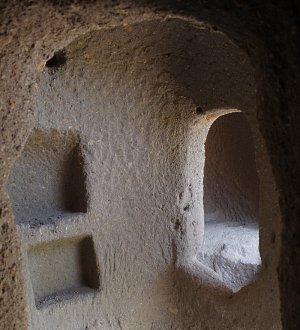
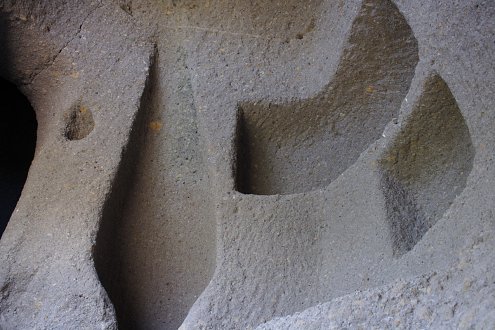
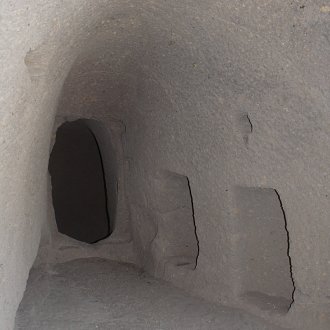
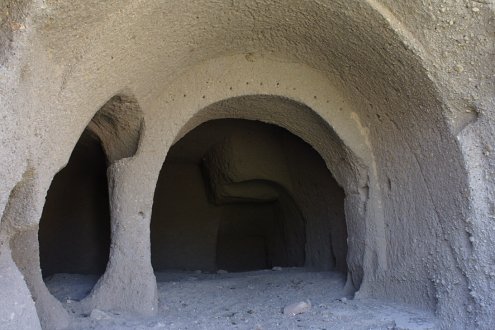
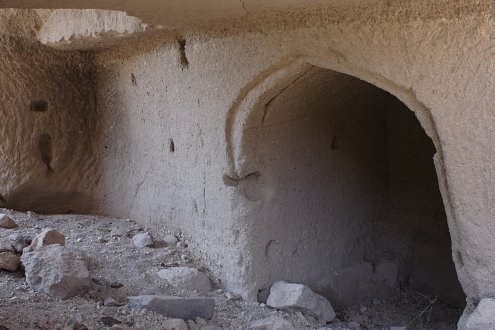
Many (probably the majority) of the caves were dwellings complete with associated storage areas. These chamber complexes are the least regular in their designs and layouts, and often have very free-flowing, curving interiors and multiple levels [see photographs 29 to 34].
Most of the chambers were lit using windows. Old photographs suggest that many currently open-fronted caves were originally sealed off by rubble walls or timber screens. Interior walls often have small niches for lamps, and bigger, cupboard-like niches for storage. Some very large niches may have been sleeping areas. Smaller chambers, sometimes with storage pits dug in their floors, are often found grouped around a large central chamber. Occasionally, the smaller chambers have narrow tunnels that extend deep into the rock. In most cases these tunnels don't seem to lead anywhere and stop abruptly. Such tunnels may have been places of refuge (though it is notable that defensive millstone doorways, like those found in Cappadocia, do not appear to exist at Ani). A number of the chambers that are close to the surface have pyramidal ceilings with a skylight at the apex [see photograph 35], perhaps mirroring the wooden architecture found in traditional hazarashen-type houses. There are several such chambers in the Gayledzor valley.
NOTES:
1. This is a description of the Ani caves in 1905. "Very curious and interesting are the cave dwellings, of which there is a large number. The most important group are those in the Aladja Chai ravine and in the little valley running up towards the depression separating the Aladja from the Arpa Chai. The Aladja ravine is much broader and less forbidding than that of the Arpa Chai, and the banks are grassy and in places cultivated, so that it would naturally be preferred as a place of residence. A whole row of caves has been dug out of the soft tufo on what I may call the Ani block, just below the castle, another on the opposite side of the little valley, and several rows beyond the Aladja Chai. A large part of the ancient population of Ani probably dwelt in them, and many are still inhabited to this day. I entered two or three, and certainly I have never seen more primitive dwelling-places anywhere. There was no overcrowding, as each family had two or three 'rooms' at its disposal; but there was no furniture save couches made by cutting into the tufo, a few rags, and some cooking utensils. The dirt, the poverty, and barbarism were incredible. These Troglodytes were both Armenians and Tartars; I have seldom met with more wretched specimens of either race." Luigi Villari, Fire and Sword in the Caucasus, p308-309, London, 1906.
2. David Kipshize, Nikolai Tokarski (ed.), Caves of Ani, (in Russian). Yerevan, 1972.
3. Roberto Bixio, Vittoria Caloi, Mauro Traverso, Ani 2004: Indagini Sugli Insediamenti Sotterranei / Surveys on the Underground Settlements. British Archaeological Reports International Series, 2009.
4. Although the chamber is clearly marked "No. 8", it is listed as chamber M/6 in Kipshize. However, the only people who could have numbered the caves in this way were the Russian investigators - so probably the painted numbers were just used for the preliminary stages of their investigations.