|
Structure: Marr-Orbeli site 109. Other designations: The Palace of the Bagratids. History
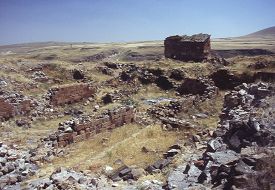
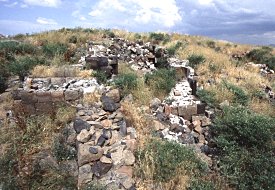
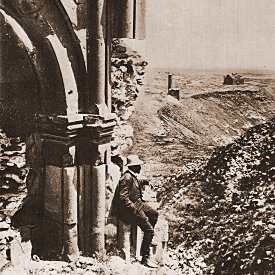
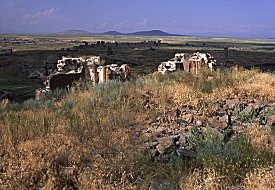
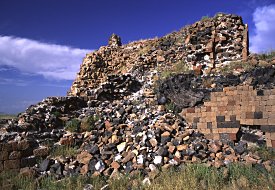
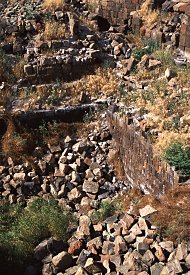
This palace was the residence of the Bagratid rulers of Ani, their successors, and probably also their predecessors the Kamsarakans. The ruins of the palace are now a confusing mass of fallen rubble and fragmentary walls. Before a series of excavations by Nikolai Marr in the years 1908 and 1909 very little of the palace was visible above ground.
The excavations gradually revealed most of the plan of the royal palace, which had been added to and reconstructed many times before being finally abandoned (probably by the end of the 15th century) and later looted for its building materials. Charred beams and other remains found during the excavations indicated that much of the palace had been destroyed by fire.
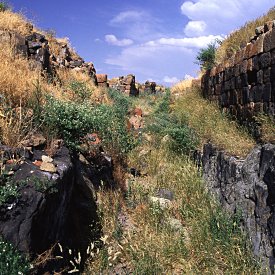
The Central CorridorThe palace was divided into two parts, a northern half and a southern half, by a narrow corridor, [b] on the plan, that was 59 metres long. The main entrance [a] into the palace was at the western end of this corridor. Marr discovered that columns had flanked the entrance, and he found stone slabs with bas-reliefs of animals that may have decorated the top of the entrance. Hidden underneath the original floor-level of the corridor was a narrower passageway that had been cut into the natural rock.
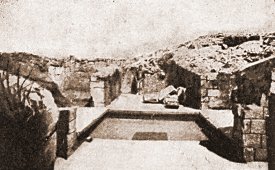
The Palace BathhouseWedged between the cruciform hall and part of the original north wall of the citadel was a small bathhouse [e].
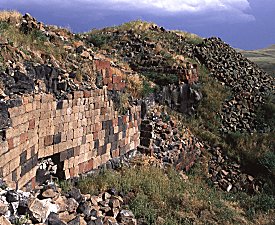
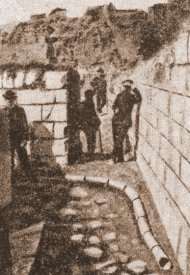
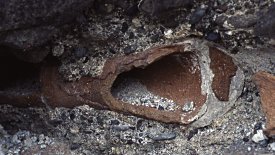
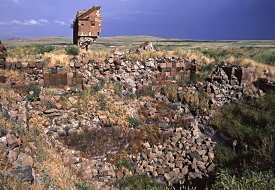
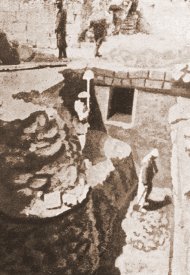
This bathhouse had two main compartments that were separated by a narrow room containing a cold-water reservoir and a caldron intended to heat the water. The bath's eastern compartment had a hypocaust floor supported on six columns. This floor had been covered with a thick coating of waterproof plaster. The walls had also been plastered, painted red, and had been given a foliated decoration. Within the compartment's east wall were perpendicular pipes that had served as ventilation flues for the under-floor area. In its north and south walls were small basins that had been supplied with water from clay pipes embedded within the walls. Another set of pipes, taking water from the bathhouse, ran from under the entrance of the eastern compartment towards the slope of the citadel hill. A small arched opening led from the eastern compartment into an entrance room that had a small footbath in its south wall. From this entrance room another arched opening led into a changing room that had a raised area for resting upon. A narrow corridor linked the changing room to the western compartment. Marr discovered another line of clay pipes running under the floor of the western compartment (see photograph 7), and at its southern end was a small chamber with a hypocaust floor supported on four columns. The Ceremonial HallsMarr's excavations revealed that three "ceremonial halls" had been located within the northern half of the palace: they are known as the north-west hall [f], the east hall [g], and the north-east hall [h]. Their floors were all at a higher level than the rest of the palace, and it is possible that the flat roofs of the rooms on the lower levels formed an internal courtyard or veranda for the ceremonial halls.Before Marr had started to excavate, a carefully constructed fragment of an unknown building was visible high up on the citadel (see photograph 9). This was later understood to be the only surviving part of the north-west hall [f]. The fragment has since fallen, at an unknown period and under unknown circumstances (it was gone by the early 1960s). The north-west hall had an internal length of 20 metres, a width of 10 metres, and had windows that overlooked the city. Its interior was powerfully articulated using only the architectural detailing of arches and pilasters: there were no frescoes or other applied decoration. Later inhabitants of the palace had adapted the hall's grand interior to their more basic needs, subdividing it into four rooms using material taken from other buildings.
The east hall [g] took the form of a basilica. This hall was built above a series of vaulted rooms, within which Marr found many architectural and decorative fragments that had fallen from the hall. The evidence of those fragments revealed how richly decorated the interior of the hall had been. Marr later wrote: "...the artefacts collected were sufficient to confirm that the zeal of the builders had been concentrated on decorating this hall in an exceptional manner. The tales in old Armenian accounts of the gold covered rooms in the royal palace of Ani had seemed to us to be only legendary exaggerations. Remains found in the underground level of the basilica hall allow us to establish that it was not a legend, but the literal truth".
Marr found that most of the north-east hall [h] had collapsed down the slope of the citadel: only the lower courses of its southern end remained. More of the basement of the hall had survived, within which a large number of plaster tiles were found. Some of these tiles bore plant decoration, others depicted animals, including a deer and a bear. These tiles The appearance of the north-eastern end of the palace has changed considerably since Marr's excavation. A large section of the excavated area - including most of the east hall [g] and most of the bathhouse [e] - appears to have been filled in and built up to form a low, flat-topped mound. The citadel is said to have housed a small military post during the early years of Turkish control. This mound may have been constructed to provide a foundation for part of that military post. The Southern Section of the PalaceThe southern half of the palace was only partially excavated by Marr. From the central corridor a narrower corridor led to a spacious hall [i], whose floor was paved in carefully cut slabs of stone and whose walls, in places, contained small basins. There was a deep niche, divided by a column, set into the southern wall of the hall. There was also an annex to the west which had its floor level raised above the level of the rest of the hall. Marr found the remains of wooden boards, painted with geometric and foliated motifs, which, he assumed, had formed a partition screen between the hall and the annex room.Underneath the floor of the hall Marr discovered a large, stone built, cistern. This cistern was divided into two vaulted compartments - each four metres deep, seven metres long, and three metres wide - that were linked by two arched openings. He discovered two sets of water conduits connected to the cistern: one was composed of clay pipes, and the other of narrow iron pipes. Marr postulated that the water conduit under the citadel entrance had led to this cistern. At some period the cistern had gone out of use and had been filled with earth. Marr's excavation of the cistern was surprisingly damaging, since it involved the destruction of the entire floor of the hall. Marr's interest was probably in the possibility of finding artefacts inside the cistern. Within the cistern he did discover fragments of a wooden column bearing a fresco portrait of a crowned person. To the southeast of the hall there was an open courtyard [j]. At the eastern end of this courtyard is the structure known as the Palace Church [k].
|
|
|
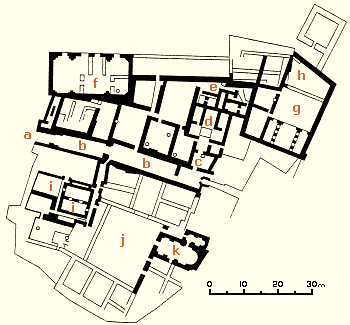
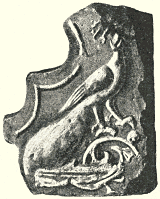 Two openings linked the corridor to the northern half of the palace. The one at its eastern end led into a vestibule [c] that in turn led into a hall with a cruciform plan [d]. This hall was paved with stone slabs and had a rectangular central space with wings that opened out on each of its sides (see photograph 5). The floors of the west, east, and north wings were raised slightly above the central space. In another room to the north of the corridor fragments of stucco decoration were found, including a fragment bearing a relief of a peacock standing on a foliated base (see the illustration, above left).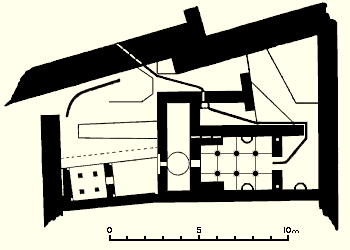
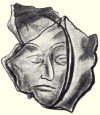 Two rows of wooden columns had rested on stone bases and supported an arcade of timber arches. The columns had been decorated with paintings and the arches had contained wooden sculpture. A frieze, painted onto wood and framed by plaster rosettes gilded in gold, had run above the level of the arcade and had depicted persons of nobility, perhaps kings and queens. The illustration, above right, shows a fragment from this frieze. The wooden ceiling also had
 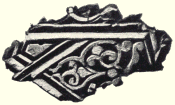 sculpture and painted decoration on it. The walls of the hall had frescoes depicting flower gardens and groups of horsemen. The plaster showed traces of destruction by fire. Charred fragments of carved wood were found - perhaps from a window frame (see the illustration on the left). Charred fragments of fabric were also discovered that might have been part of a curtain.
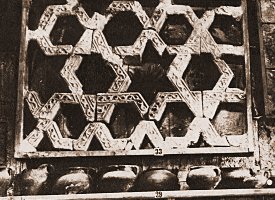
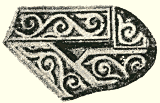 were fragments of the interior decoration of the collapsed hall. Some of the plaster tiles, including the one illustrated on the right, were part of a latticework grill containing small polygonal openings. Part of this grill was later reconstructed and put on display in the Ani museum (see photograph 15).