|
Structure: Marr-Orbeli towers 75, 77, 79, 81, 83, 85, 87, 89, and gate XV.
Description
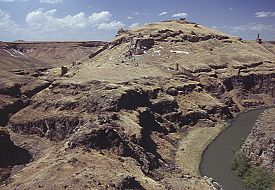
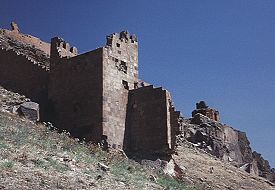
Walls descend from each side of the citadel hill towards the edge of each ravine. The wall that descends from the western side of the citadel is said to date from the 13th century and is, at first glance, curious because it appears to be facing the wrong way. This is because it was designed to protect the flat area to the south of the citadel, which comprised a separate fortified enclosure.There are no traces of buildings in this enclosure, only the remains of the graveyard mentioned below. Perhaps it was deliberately left as an open space for livestock.The wall that decends from the eastern side of the citadel would have stopped successful assailants of the enclosure from working their way around the citadel to attack Ani from its eastern side. Attackers taking this route would have, in effect, to break through three sets of walls before entering the city.
|
|
|
|
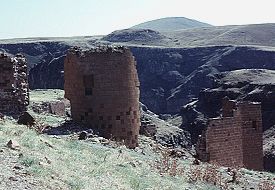 3. A gateway through the wall on the western side |
|
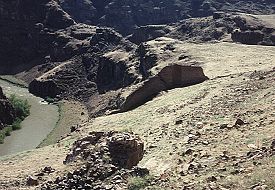 4. Wall descending from the east side of the citadel |
| The GraveyardOld engravings of Ani depict several graveyards around the city, as well as isolated khatchkar gravestones. These have all apparently been destroyed. A graveyard is located on the flat space to the south of the citadel hill, before the Kizkale peninsular. Little is now visible except a few half buried gravestones.A khatchkar (which means "cross-stone" in Armenian) is a large rectangular slab of stone, set upright in a base and with a cross carved on their western facing side. As well as serving as grave markers they were also often erected for commemorative or votive reasons.
On the cliff that mark the southern edge of the citadel hill, are chambers cut into the rock. Some are dovecotes.
|
|
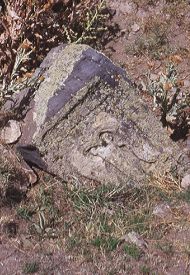 5. Gravestone in the graveyard below the citadel |
|
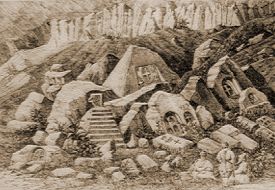 6. An old engraving showing a graveyard in Ani |
|
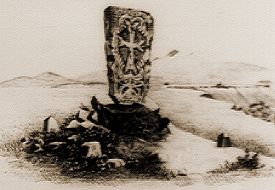 7. Old engraving of a freestanding khatchkar in Ani |