|
|
The artist and art historian Arshak Abrahmi Fetvadjian ¹ was born in October 1866 at Trebizond (modern Trabzon) in the Ottoman Empire. At Constantinople he studied painting at the State Fine Arts School (also known as the Imperial Academy of Art), graduating from there in 1887. This school was founded in 1883 by the Armenian sculptor Ervand Vosgan (1855-1914), after getting support from Ottoman notables such as Osman Hamdi Bey (1840-1910), the director of Constantinople's Museum of Antiquities. Most of the teachers were foreigners, mainly Italians, and most of the students were non-Turks, the majority being Armenians. Another Ani connection with this school is through Toros T'oramanian (1864-1934), who was a graduate of its architecture department. Fetvadjian also trained at the San Luca Art Academy in Rome from 1887 to 1891. He lived, worked as an artist, and studied in Vienna from 1891 to 1895, before moving to St. Petersburg where he became a member of the Society of Russian Watercolour Painters.
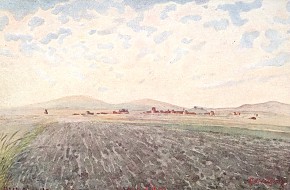
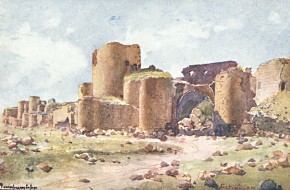
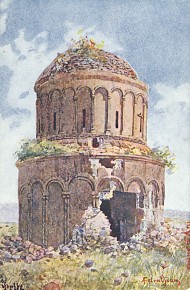
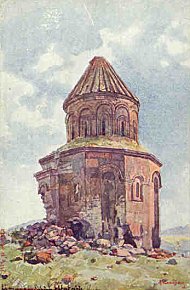
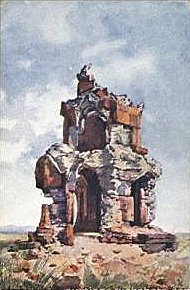
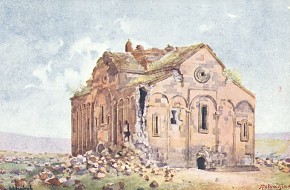
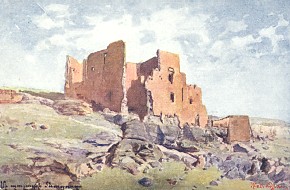
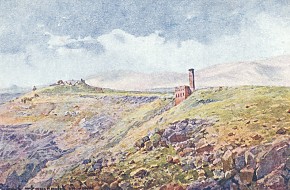
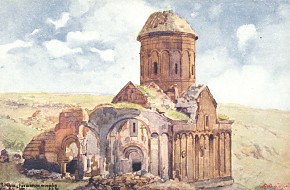
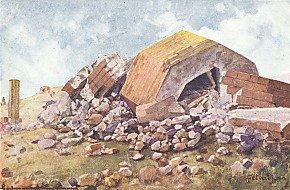
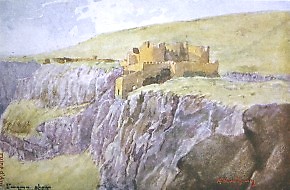
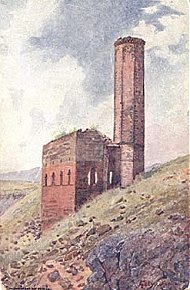
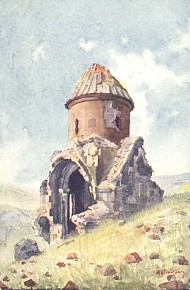
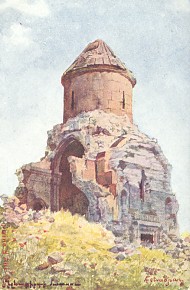
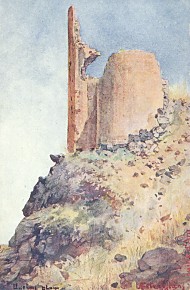
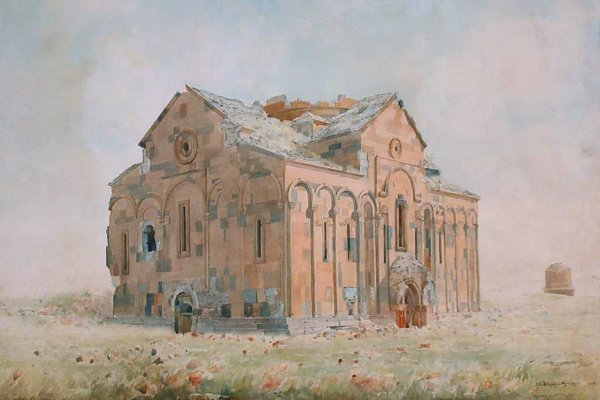
At the start of the 20th century Fetvadjian visited Ani in order to paint the ruins. When Nikolai Marr's excavations restarted in 1905 Fetvadjian was also was involved with them. Fetvadjian's paintings of Ani were factual and literal depictions of the buildings and were mostly done in watercolour.
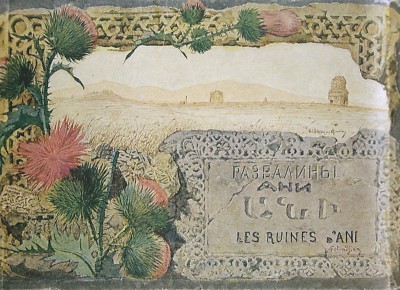
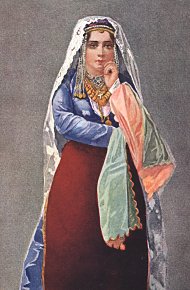
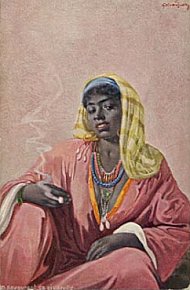
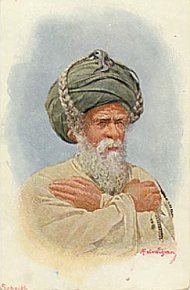
In the following years a large number of his watercolours were published as postcards. Most of these postcards depict buildings at Ani; a few are of other locations in Armenia; some are studies of the various races inhabiting Transcaucasia and elsewhere, shown wearing their national costumes. The majority of the paintings reproduced on this page are taken from these old postcards. An album titled "Les Ruines d'Ani", containing 15 postcard-sized reproductions of Fetvadjian's Ani watercolours, was published in Vienna in 1903. At around the same time the same watercolours depicted in the album were issued as postcards. There was probably at least one reprint of the postcards - some of the cards are marked "made in Austria", others are not.
As well as his work documenting ancient Armenian monuments, Fetvadjian also collaborated with various publishers and writers and wrote many articles and reviews about Armenian art and architecture. He was also involved in the design and decoration of a number of Armenian churches, including fresco murals inside the Kamoyants Surp Kevork church in Tiflis, which had been restored from 1900-1908, and the design of the wooden doors of the newly-built Surp Grigor church in Kars. Both these buildings no longer exist, though the Surp Grigor doors survive in a damaged condition in the Kars archaeological museum.
|
|

Arshak Fetvadjian in the 1900s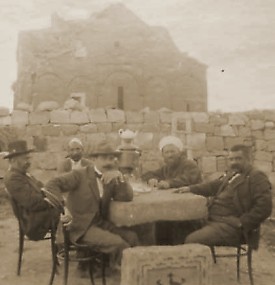
Arshak Fetvadjian and Toros Toramanian at Ani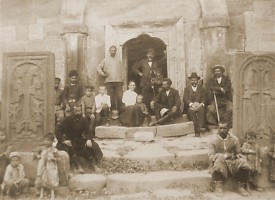
Arshak Fetvadjian (seen standing in the doorway) with Nikolai Marr at Horomos monastery near Ani
|
|
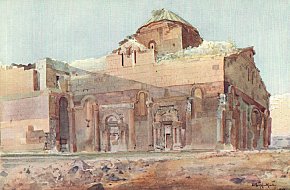
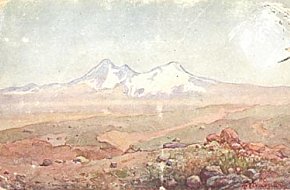
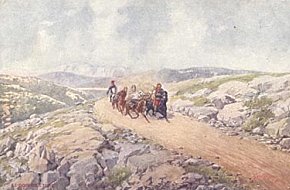
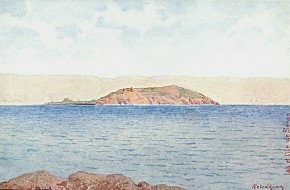
All of the above paintings depict scenes at Ani. The large painting of the Ani cathedral is a watercolour done in 1905 that is now in the National Gallery of Armenia. The cover of the 1903 album "Les Ruines d'Ani" is also shown. Below are some of his paintings depicting other parts of Armenia: the Tekor basilica; Post Sarerum ("Mail at the Hills") also known as Arevelyan Post ("Oriental Post"); Aragatz mountain; Lake Sevan.
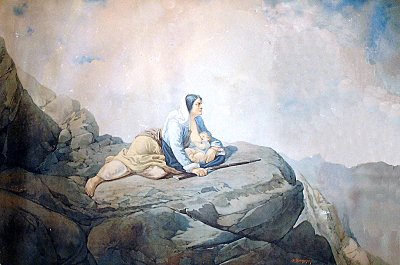
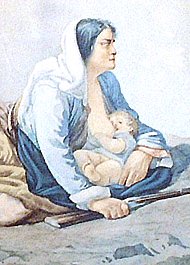
Below are some of his ethnic figurative studies: an Armenian woman, a negro woman, an Arab sheik. Below them is a patriotic work titled Sasuntsi Kin, "The Woman of Sasun".
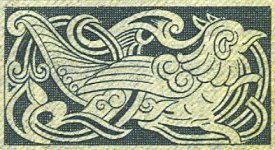
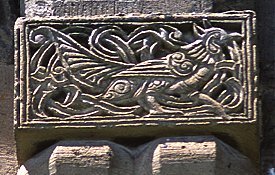
The Armenian Republic chose Fetvadjian to design and supervise the production of its new paper currency and postage stamps. Crudely-printed, locally-produced banknotes were already in circulation, along with Russian stamps overprinted with Armenian symbols. The new banknotes were printed in Britain and the postage stamps were printed in France. Some design details on the banknotes contain motifs derived from buildings at Ani. For example, the 100-rouble note (pictured opposite) has a bird-like animal motif copied from an impost block on the east facade of the Tigran Honents church, and the motif at the top of the note is from a capital inside the Palace church.
Fetvadjian was in Paris directing the printing of these items when the Armenian Republic fell under the control of the Bolsheviks. Some books incorrectly say that the stamps and notes did not reach Armenia. However, the banknotes do seem to have been entered into circulation in parts of Armenia. Some of the postage stamps also reached Armenia although they were never used for their intended purpose: in the 1920s they were overprinted for use in Soviet Armenia as revenue stamps.
During 1919 and 1920 he had paintings exhibited in Paris and London. In 1922 Fetvadjian emigrated to the United States of America and settled in Boston, the intellectual centre of America's Armenian community, through the help of Manuel Der Manuelian who had been a consul of the Armenian Republic and lived in Boston. Fetvadjian continued to paint and exhibit his works, though on a decreasing scale as he found himself isolated both artistically and socially and had difficulty obtaining commissions. In New York he designed an altar for the Armenian cathedral of the Holy Illuminator and painted an altar portrait of the Madonna and Child for it. He died in Medford, Massachusetts, on the 7th October 1947. In 1947, shortly before his death, he bequeathed his entire collection of paintings to the National Gallery of Armenia. After his death his remains were transferred to Yerevan. During his career he is said to have painted over 2,000 oils and watercolours, many of which were of architectural or archaeological subjects.
NOTES:
1. Fetvadjian's surname appears in a variety of forms, including: Fetvajian, Fetvajyan, Fetuajian, and Fedvadjian. His first name is sometimes written as Arshag. He signed his artworks "Fetvadjian", so the other variants of his surname are not valid. The "yan" ending is a rendering into English of the Soviet-period spelling reform (some would say "Russification") of Armenian name endings. This Russian influence still continues: by law, for the rendering into English, all last names in Republic of Armenia passports are by default written with "yan" and "ian" can only be used by special request.
|
|
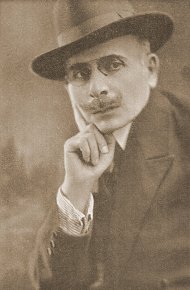
Arshak Fetvadjian in a photograph
taken in New York in the 1920s
|
|
|