|
What is a Stereoscopic Photograph?
Stereoscopic photography is based on the principle that if two photographs are taken of a subject from viewpoints approximately equal in separation to the distance between the human eye, then the two photographs will merge into a single three-dimensional image if they are viewed in such a way that each eye sees only the appropriate left or right side photograph.
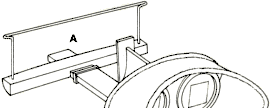
The principle of stereoscopic vision was discovered by Sir Charles Wheatstone in 1832. This was before the invention of photography, so he used pairs of drawings. Later, in 1841, the first stereoscopic photograph was produced. The viewers that were used to view these early stereoscopic images (which are also called stereographs) were constructed of bulky mirrors and prisms, but in 1849 Sir David Brewster invented a viewer that used lenses.
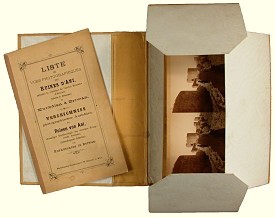
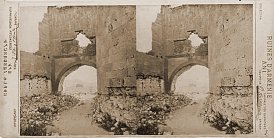
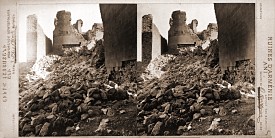
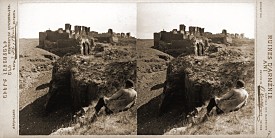
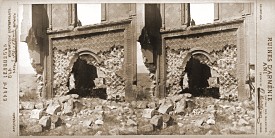
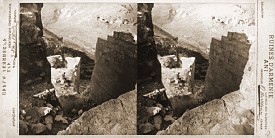
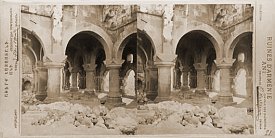
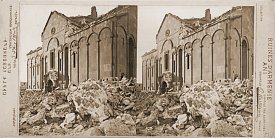
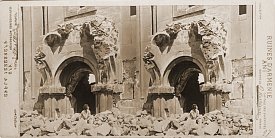
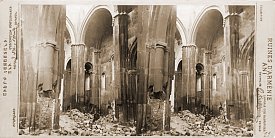
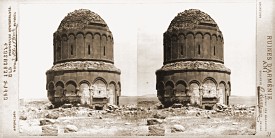
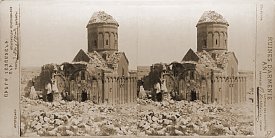
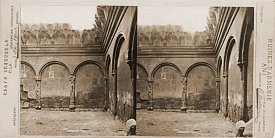
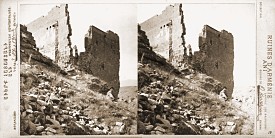
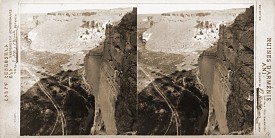
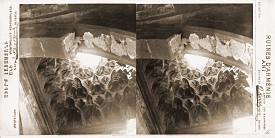
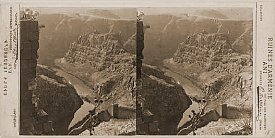
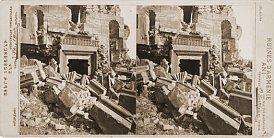
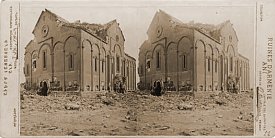
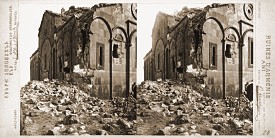
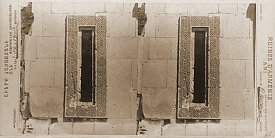
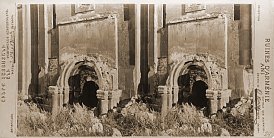
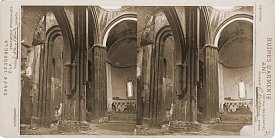
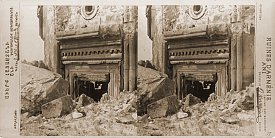
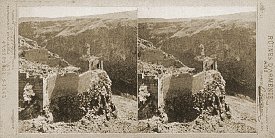
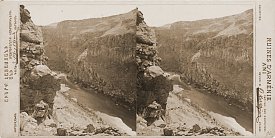
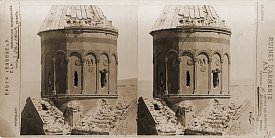
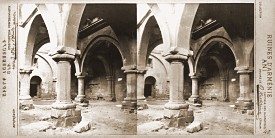
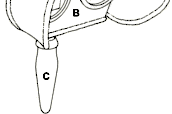
Special stereoscopic cameras were also produced. Although stereoscopic photographs can be made using an ordinary camera (moving it sideways by several inches between taking the two photographs), the pictures must be very accurately aligned and capturing a moving image is impossible. The process is made much easier by using a proper stereoscopic camera. These cameras either had a single lens fitted on a panel that slid sideways, or were fitted with twin lenses. Since some of Kurkdjian's stereoscopic photographs show people - difficult to take with a normal camera because of the risk of movement - he probably used a stereoscopic camera. Below are two probably unique surviving examples of Kurkdjian's uncut stereo photographs that would have been used to make the stereo views.
Kurkdjian's Stereoscopic Photographs of Ani
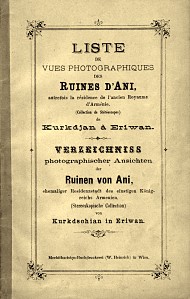
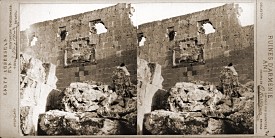
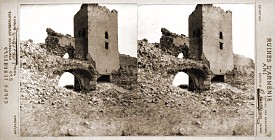
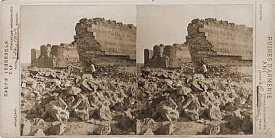
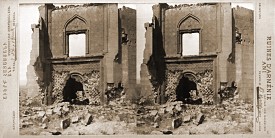
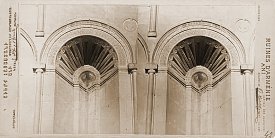
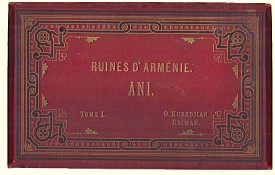
While living in Yerevan, Kurkdjian produced a set of stereoscopic photographs (stereographs) depicting Ani. It is not known exactly when the photographs were
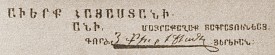
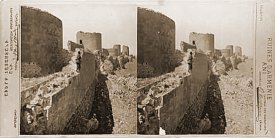
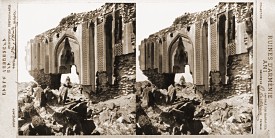
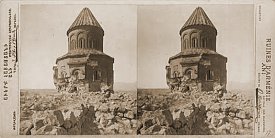
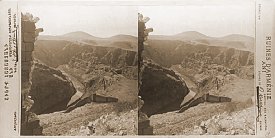
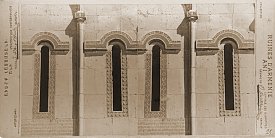
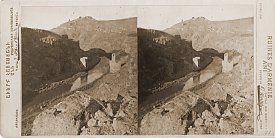
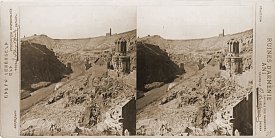
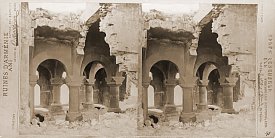
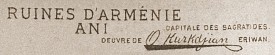
The pairs of photographs are mounted onto printed cards manufactured in Vienna, and are the standard 90x180mm size. All the cards have the title "Ruines d'Arménie, Ani" and a facsimile of Kurkdjian's signature. They do not have individual captions, but each card is hand numbered according to the listing in the accompanying booklet. The back of the cards either have the name "Eisenschiml & Wachtl, Wien" or "A. Moll, Vienne". Both these companies operated photographic businesses in Vienna selling camera equipment and supplies, including the backing cards for cabinet photographs that were supplied to photographic studios, often with ornate logos on their verso. I have not seen a large enough quantity of Kurkdjian's stereo cards to be certain, but I think that his cards bearing the name "Eisenschiml & Wachtl" predate those with the name "A. Moll". The backing card used for the A. Moll cards is thinner and of poorer quality, and the printing on them is slightly rougher. There are also differences in what is depicted. For example, for cards 20 and 21, although the buildings depicted are the same, the images come from different negatives. And the negatives used for the Eisenschiml & Wachtl" cards 20 and 21 have a superior stereo effect compared to those used for the A. Moll cards 20 and 21. Probably the original negatives were damaged and had to be replaced with less satisfactory negatives for the A Moll edition.
It is said that the Russian authorities suspected that Kurkdjian's photographs documenting Armenian culture were intended to promote sedition, and that this was one of the reasons why he left Armenia. It is perhaps significant that the cards are inscribed in Armenian and French, rather than in Russian and French. Also perhaps significant are the poses of some of the people in the cards. They seem to match the pose of the female figure in the well known engraving from 1861 by Chanik Aramian, titled "Armenia in Mourning" or "Ruins of Armenia", in which a woman is depicted sitting in a ruin-filled landscape, contemplating Armenia's past glory. By the 1870s this "Mother Armenia" figure had become an important patriotic image and an emblem for the liberation of the Armenian nation. 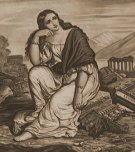 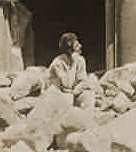 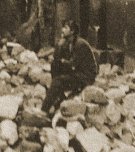 Engravings based on Kurkdjian's stereo photographs also exist: in 1885 several were reproduced in "The Graphic", an illustrated weekly newspaper published in London. A German article about Ani (of unknown date and source, but probably from the 1890s) also reproduces some of Kurkdjian's photographs as engravings. As well the set by Kurkdjian, other stereocards depicting Ani exist. See the following page for more details about them. Below are images of the cards in Kurkdjian's collection. (Thank you Wolfgang Wiggers for providing VirtualAni with many of these images). The larger versions of card n°21 and card n°22 have been scanned at 300dpi. If printed at that resolution, or at a width of 180mm, they can be used in a stereoscope viewer.
|
|
|
|
|
 Onnes (or Ohannes) Kurkdjian, born in 1851, was an Armenian photographer who was based in Yerevan for part of the 19th century. Kurkdjian later emigrated from Armenia. He lived in Singapore for a short period - spending just over two months there in 1885 and working for another Armenian photographer. He then moved to the port town of Surabaya on the island of Java, Dutch East Indies (now Indonesia), where he continued his profession as a photographer. He eventually owned a photographic "atelier" studio in Surabaya, with more than thirty photographers and darkroom assistants, producing photographs that are now highly prized for their topographical and anthropological content. The studio's photographs were also reproduced on picture postcards. He died in Surabaya in 1903 (some accounts say 1901, or 1904). After his death the company was taken over by the pharmaceutical import company "Helmig" and images bearing the name "Photografisch Atelier Kurkdjuin" continued to be published into the 1930s.