
A brief history of Armenian Sivas
In the year 1021, king Senekerim-Hovhannes Artsruni ceded the Armenian kingdom of Vaspurakan to the Byzantine Empire. He was given the Byzantine province of Sebastea as compensation. This province probably already had a substantial Armenian minority (an Armenian bishopric is known to have existed in the city of Sebastea at least as early as 986). Senekerim and a large number of his subjects moved to Sebastea - today called Sivas.
When Senekerim died in 1027, his body was returned to Vaspurakan to be buried at Varagavank. He was succeeded by his son Davit and, after the latter's death in 1035, by Atom-Ashot and Apusahl, the younger brothers of Davit. They may have both died in 1080 or (depending on the source) were still ruling Sivas when it was captured by the Seljuk Turks in the mid-1080s. That event ended the political independence of Armenian Sivas, but substantial numbers of Armenians continued to live in the region, sometimes surviving periods of great hardship.
In the 19th century the vilayet (province) of Sivas comprised four sanjaks (counties): Sivas, Tokat, Amasya, and Shebin-Karahisar. The sanjak of Sivas, whose territory was approximately the same as the present-day Turkish province of Sivas, was subdivided into 11 kazas (districts). Population statistics for this period are unreliable and vary. Their figures suggest that the Sivas vilayet had a total population of between 1,170,000 and 1,470,000, with the number of Armenians being between 152,000 and 200,000. Most of those Armenians (at least 100,000 of them) lived in the Sivas sanjak. The city of Sivas had a population of about 45,000, and more than a third were Armenian.
At the start of the 20th century the Armenian Church in the vilayet of Sivas was divided into seven dioceses. Three of the dioceses - Gurun, Divrik, and Darende - were under the jurisdiction of the Catholicos of Cilicia. The remaining four dioceses - Sebastia (Sivas), Amasya, Evdokia (Tokat), and Shebin-Karahisar - were under the jurisdiction of the Armenian patriarch in Constantinople. There was an archbishop in the diocese of Sebastia, and bishops in the other six.
The diocese of Sebastia, whose area comprised most of the sanjak of Sivas, had 74 parishes with 56 churches and about 80,000 church members. The archbishop resided at the monastery of Surp Nishan (Holy Sign), about three km outside Sivas.
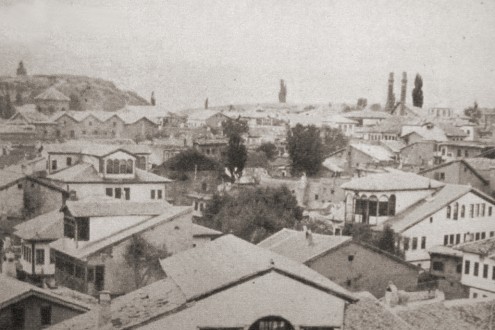
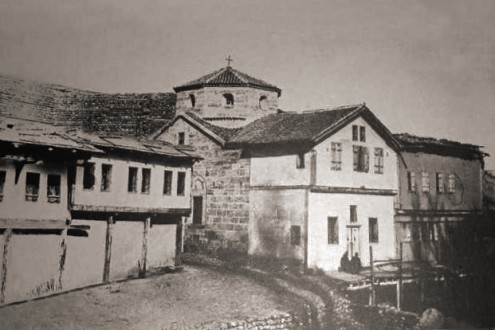
In Sivas there were at least four Armenian Apostolic churches: the cathedral of Surp Astvadsatsin and the churches of Surp Hagop, Surp Prkich, and Surp Sarkis. Some sources also mention a Surp Minas church and a Surp Georg church. The cathedral was a large structure with a tall dome, seven altars, and dated from a rebuilding in 1803 [see photograph 1]. The city also had Armenian Catholic church (dedicated to St. Blasius, a 4th C. saint martyred in Sebastia) and an Armenian Protestant church. The town's Greek Orthodox Christians also had their own churchs.
During June and July 1915, most of the Armenians of Sivas vilayet were either killed or were deported in ways designed to bring about their deaths. In September 1919 the American Military Mission to Armenia arrived in Sivas, en-route to destinations further east. They discovered that of the possible 200,000 Armenians of Sivas vilayet before the war, only some 10,000 remained. Those survivors were mostly living in abject poverty, unable to reclaim their property, and fearful of new massacres (in 1919 Sivas was a centre of the Turkish Nationalist movement). Most were making preparations to leave. There were 1363 Armenian orphans in Sivas, in orphanages of the American-run Near East Relief.
In 1925 there were reportedly around 3,000 Armenians left in the vicinity of Sivas. By 1929 this number had fallen to 1,200. A 1939 source gives a figure of around 2000, out of a total population of about 35,000. There were about 300 Armenians still living in Sivas in the 1970s, this had dwindled to under 50 by the late 1990s. There is also still a scattering of Armenians, mostly elderly, in villages around Sivas. Many villages also have one or two inhabitants who will say that they have Armenian mothers or grandmothers (and probably many more who will not publicly admit it). [see note 1]
Surp Nishan monastery
The monastery of Surp Nishan (meaning "Holy Sign" or "Holy Cross"), also spelt Surp Nshan, seems to have been established by Atom-Ashot, the son of King Senekerim, probably while his father was still alive (i.e. before 1027). The monastery was named after the celebrated relic that Senekerim had brought from Varagavank, and which was returned there after his death.
The Catholicos of the Armenian Church, Petros I Getadardz, lived in Sivas from 1023 to 1026 before returning to Ani, the then seat of the Armenian Catholicosate. In 1046, after the capture of Ani by Byzantine forces in 1045, Catholicos Petros was banished from the city and forced to reside in Erzurum. In 1049 he returned to Ani, where he consecrated his nephew Khachik as Catholicos, but was summoned to Constantinople where he remained in semi-captivity until 1051. Petros was then allowed to live in Sivas but was forbidden by the Byzantine emperor to return to Ani. He took up residence in Surp Nishan monastery, where he built a residency. After his death in 1058 he was buried in a tomb inside the monastery, below the east wall of the Surp Astvatsatsin church.
In 1387/88, Step'anos, the archbishop of Sebastia, was executed for refusing to convert to Islam. For a while the monastery of Surp Nishan was converted into a dervish sanctuary, and other churches in Sivas were demolished. [see note 2]
In 1915 Surp Nishan monastery was the main repository of medieval Armenian manuscripts in the Sebastia region and at least 283 manuscripts are recorded.
In 1939 the traveller H. E. King visited Surp Nishan. He found that the monastery was being used as a military depot and he was unable to go inside. He wrote that the walled enclosure of the monastery was still intact and the main church appeared to be "in an excellent state of preservation", complete with its dome.
The monastery is now entirely destroyed and a sprawling military base occupies the site. The date of the destruction is uncertain. A short article in The Armenian Reporter of March 30, 1978 says that news had reached Istanbul that the Surp Nishan church in Sivas was being demolished, and that the Armenian Patriarchate of Istanbul was expected to lodge a complaint. Some books [see note 3] say that the last remnants of the monastery was demolished in the 1980s. A religious shrine (a Muslim one) of some sort still exists within the army base and can be visited for several hours on one day of the week.
Description of Surp Nishan
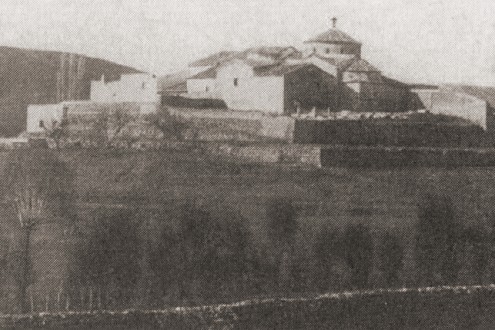
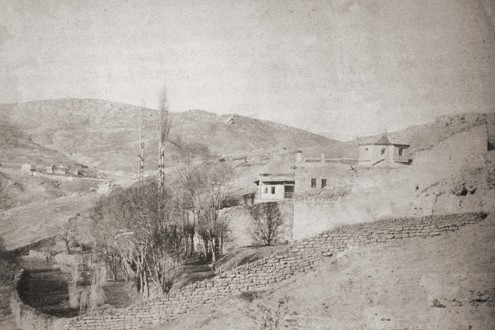
The monastery stood on a low hill overlooking Sivas and was surrounded by a plain and undefended outer wall. On one side of that enclosure wall, encircled by a wall of mud brick, was a large garden containing fruit trees and vegetable plots. Several farms were also attached to the monastery.
The monastery had three churches – their names were Surp Astvatsatsin ("Holy Mother of God"), Surp Khatch ("Holy Cross"), and Surp Hovhannes Karapet ("Saint John the Precursor").
Surp Astvatsatsin was a domed church with a "Hripsime-type" plan. According to the 11th-century historian Aristakes of Lastivert, it had been modelled after the church of the same name at the monastery of Varagavank and contained the throne of king Senekerim-Hovhannes. This throne (or one claimed to be it) was still preserved in the monastery until 1915. The Surp Astvatsatsin church was renovated at the start of the 20th century. The Surp Khatch church (also called Surp Nishan) had a "domed hall" design, rectangular in layout, with massive buttresses supporting its dome. It seems to have been the main church of the monastery. In the 19th century its interior was whitewashed and parts of the walls and floor clad in Kutahiya tiles. The Surp Hovhannes Karapet church, the smallest of the three, was restored in 1857.
Foreign visitors described the monastery's ancillary buildings as spotlessly clean but very bare; "the walls are covered with plain hangings; heavy, padded leather curtains take the place of doors to the cells and the woodwork is unpainted; the whole place is warmed only by charcoal braziers".
Surp Anapat monastery
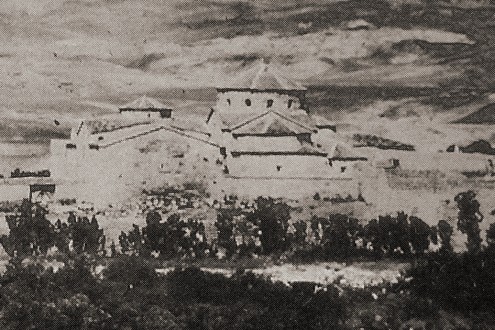
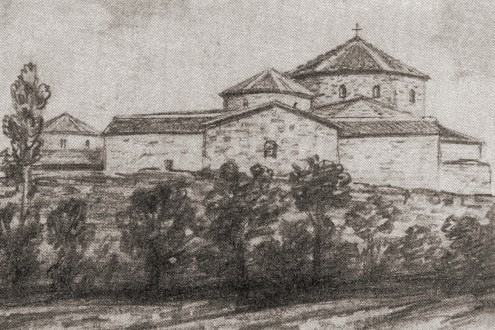
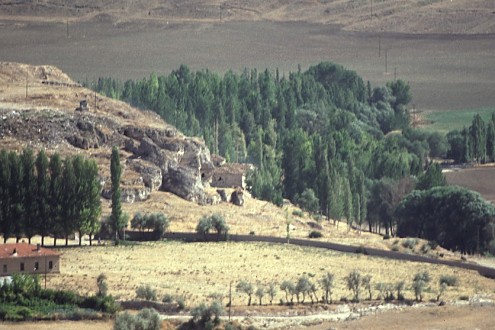
There were two Armenian monasteries located close to Surp Nishan. The monastery of Surp Hagop ("Saint James") was on the side of a hill, and the monastery of Surp Anapat (also spelt Anabad) [see photographs 5 & 6] was opposite that same hill. The Anapat monastery was also known as Surp Astvatsatsin Charakhapan of Sebastia, and was said to be near a village called Dahuray. 13th century manuscripts that were created in this monastery still survive.
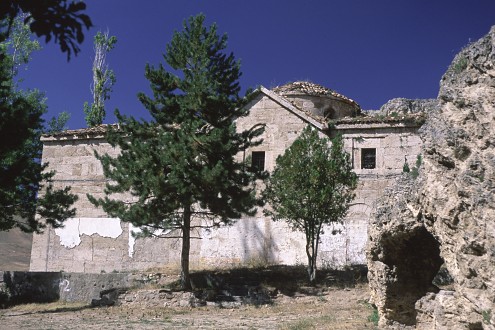
The main church of the Surp Anapat monastery is still standing. It lies inside the same army base that occupies the site of Surp Nishan. It can be observed discreetly from outside the base's perimeter fence, but it is usually not possible to get closer.
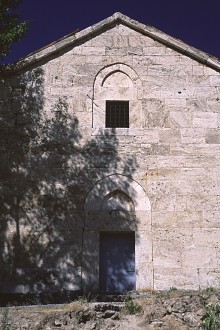
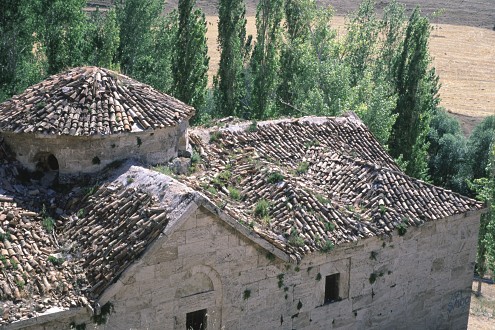
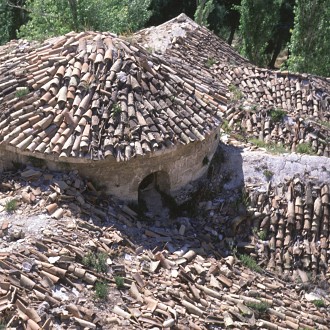
The church is constructed from well-cut blocks of stone but is very plain, without any external ornamentation or inscriptions. It is not an old building and probably dates from the end of the 19th century or start of the 20th century. The church has a dome with a cylindrical and unusually short drum that is pierced by four circular windows. It is possible that this drum and dome are not the originals. The roof is covered in clay tiles with a half-cylinder profile.
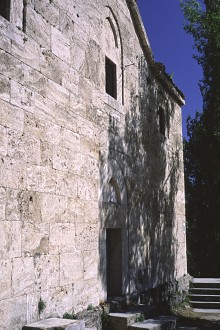
There is a single entrance on the west facade, barred with a modern door made of thick steel. During my visit to this site it was not possible to observe the interior of the church, but it is probably a basilica with columns. There is a second entrance, now blocked-up, at the eastern end of the south facade. On that facade are the marks of buildings that once stood against the church – they are all now demolished. Above the church are several artificial caves with doors and windows cut from the rock, but nothing else of the monastery survives.
Photographs five and six, which depict the Surp Anapat monastery, show a church that is different from the surviving church. The church in the photographs has an octagonal drum - on the surviving church it is circular. The church in the photographs is also shorter in length, has a window high in the north gable, and has a house-like structure built against its west facade. The current church has none of these, and seems to be the result of a complete or almost complete rebuilding of the church depicted in those old photographs.
The graveyard near Surp Anapat
Before the Genocide, the main burial place for the Armenian population of Sivas was a large graveyard located about ten minutes walk to the south of the city. It is now entirely destroyed. Its site seems to lie under the railway sidings of the train line to Ankara, laid in the 1930s.
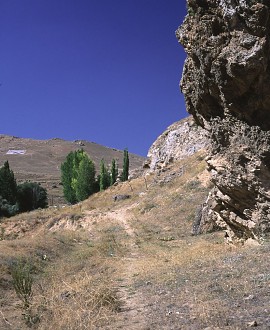
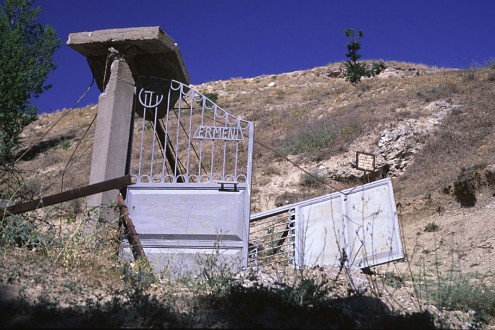
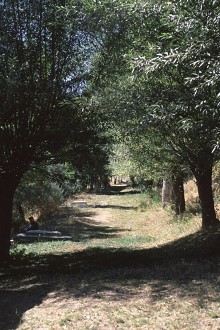
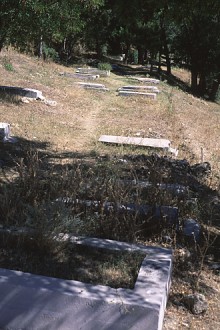
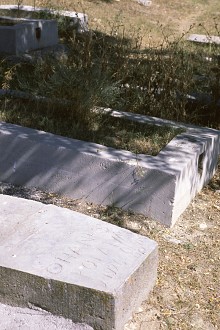
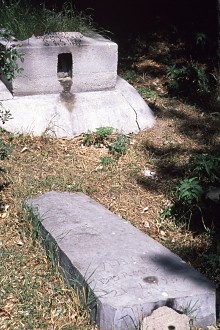
An Armenian graveyard still exists in Sivas: it is entirely modern and dates from the 1940s. It is located close to the Surp Anapat church and lies just outside the perimeter fence of the military base. The graveyard is in two sections – an upper section is on the bare slope of a hill, a lower section is laid out along a tree-lined abandoned road that once led to Surp Anapat. The upper section appears to be slightly older, containing graves from the 1940s.
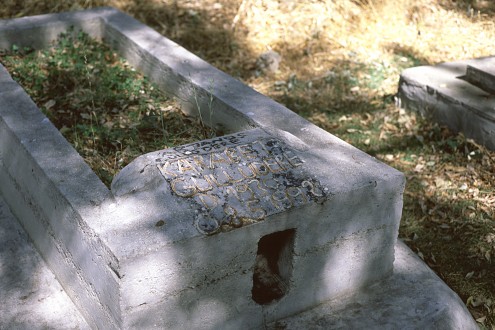
All of the graves are marked in a very simple way: the best are just coffin-shaped slabs of concrete, and many are marked only with piles of stones. There are niches in the western sides of most of the concrete grave-markers to contain burning incense or candles.
On some graves the names and dates of the deceased are scrawled crudely into the concrete. None of the dates are older than the 1940s - this probably indicates when the destruction of the old Armenian cemetery to the south of Sivas had occurred. A few of them had names and dates inscribed onto small marble plaques set into the concrete, but all of these plaques have been deliberately smashed. The graves do not have any Christian symbols on them, nor is there any Armenian lettering. On my visit I noted that some of the graves had been recently desecrated (probably by grave robbers looking for gold) and human bones lay scattered about.
When visited in 1997 [see note 4] there were approximately 125 graves in the lower section of the cemetery: 56 of them were unmarked and 13 had their inscriptions destroyed. This is a list of all the named graves in the lower section of the cemetery, those closest to the entrance are first. It was not possible to record those in the upper section because of soldiers inside the army base. Dates in Turkey are written day-month-year.
Lusin Gürnagud, born 30-12-954, died 3-12-959
S.P.O.A. Hamdemir-Ailsi 1966 (also has a drawing of a left hand with "H-H" on it)
Levon Kanber
F. N. Koptas, died 4.9.1965
Vorname Manfred, 6. Maerz 1953, died 24.11.1979
Osgan Boy, 7.9.1961
...migirdiç Dal, 1908-195... (damaged inscription)
Serkiz Migdis, born 8.5.1930, died 1.12.1968
Ernak Çakmtas, born 1910, died 1961
Betd (or Beta) Selelenk, born 1960, died 1964
Sursmak, died 4th September 1956, aged 67
Kuyumcu Vahan, Tenekeci, born 1312, died 1962
Kuyumcu Vahanin, Oiloi Gigejik, died 1968, age 32
Demicçi, Apsaham Gullep, 1890-1957
Oskihan, 1957
Siman S....nyan, 1959
Oskiyan Tarva
Keverk Bo..., 1956
Tug Suk (name is scratched over) Tavra ("Tavra" inserted later), 6-3-1967
A. Gongu, 1956
Nigoges B......oglu, 1960 (name is partially destroyed)
Levon Balcioglu, born 1308, died 1969
Mayram Bal, born 1930, died 1962
Ohanes Polatyan, born 1926, died 1962
Zakar Koçak, born 1926, died 1988
Zarman Koçak, born 1314, died 1992
S....uk Kurnaz (the name is partially destroyed, the date is destroyed)
Zakar Boy, born 1399 ... (the rest of the inscription is unclear)
Murat Dal, 1962-1963
Ovak T Akarsu - y 77 (the "T" may actually be a cross, "y" may mean "yil" = age?)
Karabet Güllüdere, born 1930, died 8-5-1992. Vartanus Güllüdere
Armav-Dal, 1888-1963
Demirci Haciy. Dal, 1931-1973
O. Cancik
B. Cancik, 1885-1961
M.M., 1306-1956
Annik Balikciyan, born 1956, died 1989
Osana Durmazgüler, born 1936, died 20-8-1969
Artin Durmazgüler, 21-1-1967
Papel Durmazgüler, 30-1-1969
Avinik (?) Durmazgüler, Hagir (?) Durmazgüler
Mayram Ölçer, born 310, died 1970. Bedik Ölçer, born 310, died 1966
Uvan Durumagüler
Lizzait (?) Babayer (?), born 1902, died 17.9.1959
Toran Kaplan
Istipan Kaplan, ...... (?), born 195... (?)
Hayganus Bozo....u, born 1944, died 1969
Hykbed, born 1911, died 1971
Arm. E.D., born 1301, died 1981
Surpuhi Koçak, born 1928, died 1974
Sandugt Balcioglu, born 1886, died 1966
Agop Durmazgüler, born 2.4.1927, died 31.7.1991
Ohannes Aslangil, born 955, died 958
Pasakoylü Bekir
Hayik Meydan, born 920, died 975
Artin Meydan, born 1937, died 1988
NOTES:
1. Most of the information in the Brief History section is derived from the following sources: Armenia: A Historical Atlas, Armenians in Turkey 100 Years Ago, Armenian Sebastia/Sivas and Lesser Armenia, Les Arméniens dans l'Empire Ottoman a la Veille du Genocide.
2. Y. Manandean, Hrh. Acharean, ed., Hayoc' nor vkanere, 1155-1843 (Armenian Neo-martyrs, 1155-1843), Vagharshapat, 1903. Quoted here: http://rbedrosian.com/d6a.htm.
3. Hovhanissian in Armenian Sebastia/Sivas and Lesser Armenia states unequivocally that "in 1980 the military authorities of the Republic of Turkey razed the Monastery of Surb Nishan – The Holy Cross". He gives as a source for this information pages 38-39 of Patmagirk-hushamatian Sebastikoy ev gavari hayutian (History of the Armenians of Sebastia and neighbouring villages), New York, 1983. In the same volume S. Peter Cowie describes Surb Nishan as "currently in a reasonable state of preservation but is not accessible" – he has probably mistaken the Surp Anapat church with the monastery.
4. For some recent photographs of the graveyard, taken in 2008 by Maggie Land Blanck, see http://maggieblanck.com/Azarian/Sivas.html (scroll down 2/3rds of the page).
SOURCES:
Robert H. Hewsen, Armenia: A Historical Atlas, 2000.
Richard G. Hovannisian (editor), Armenian Sebastia/Sivas and Lesser Armenia, Cosa Mesa, California, 2004.
Raymond H. Kevorkian, Les Arméniens dans l'Empire Ottoman a la Veille du Genocide, Paris, 1992.
H. E. King, Travels in the Ancient Province of Armenia Minor in Asiatic Review, Vol. XXXVI, 1940. Pages 102-105.
Osman Köker, Armenians in Turkey 100 Years Ago, Istanbul, 2005. Pages 224-226.
PAGE HISTORY:
29th January 2009 - This webpage is first published.
1st December 2011 - Webpage reformatted to fit new website design, extra photo of Surp Anapat added, some minor additions to the text.