AN ARMENIAN CHURCH AND GRAVEYARD
AT EDREMIT (ARTEMID) NEAR VAN

Artemid
Around 12km southwest of the city of Van is the district (İlçesi) of Edremit. The name Edremit is derived from the old name of the district's main settlement, Artemid.
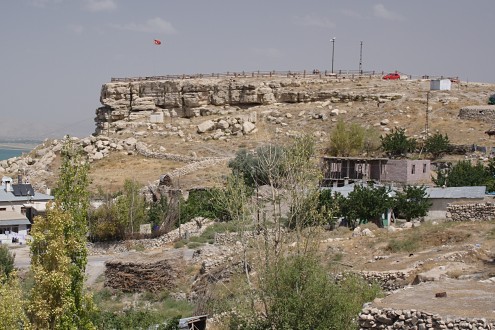
Artemid (sometimes rendered as Artamet, Atramit, Ardamed, or Adremid) was one of the best-known settlements in the Van region, partly because of the quality and quantity of its apple orchards but mostly on account of its ancient name and the legends attached to it. The famous Urartian-period Shamiram canal runs through the village and important cuneiform inscriptions have been found nearby. A tradition held that the Armenian king Artashes I (2nd century BC) had founded the village as a summer resort for Satenik, his wife. The remains of an old structure existed on the summit of a cliff overlooking Artemid and was said by locals to be the fortress and residence of the ancient Armenian kings.
In 1836, Artemid was described as being a large Armenian village of about 350 houses. In the 1820s the explorer Schulz said the village was divided into two districts: the lower half, located beside the lake, was Muslim, and the upper half was Armenian. Kevorkian writes that Artemid prior to the Genocide had around 720 Armenians in 130 households, and there were also 2400 Kurds in around 420 households [see note 1].
Artemid village is now called Sarmansuyu (at some point Sarmansuyu was officially called "Gumusdere", but this name is no longer used).
"Kiz Kilisesi"
In the summer of 2007, Turkish news reports appeared announcing the restoration of an Armenian church in Sarmansuyu, near Van [see note 2]. The reports named the church the "Kiz Kilisesi", the "Girl(s) Church". The Armenian name of this church is uncertain - the name Kiz Kilisesi probably has nothing directly to do with the church but comes from a nearby rocky outcrop that locals call Kiz Taşi or Kiz Kalesi. This outcrop, which now contains no visible archaeological remains, is probably the same place where the castle of the ancient Armenian kings was said to have been located.
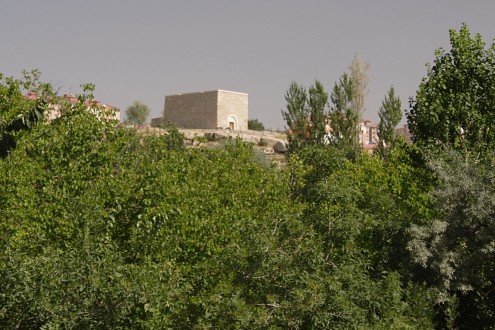
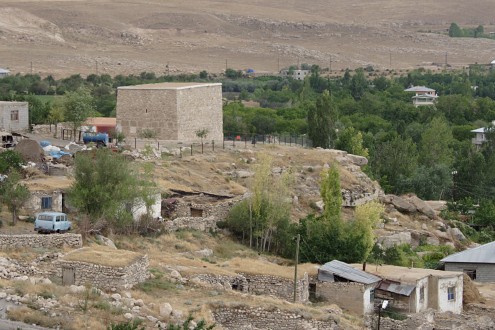
Thierry has written that all of the churches of Edremit had been destroyed with the exception of the Convent of the Mother of God, whose apse was seen by him in 1955 [see note 3]. He places that church between the villages of Zivistan and Edremit. The rebuilt church is not this building – more than just its apse survived, and it is located within Edremit, near the edge of a cliff and overlooking the lower sections of the settlement.
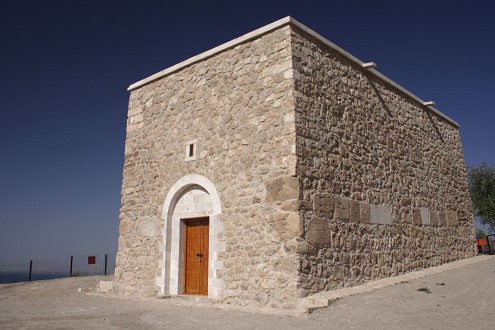
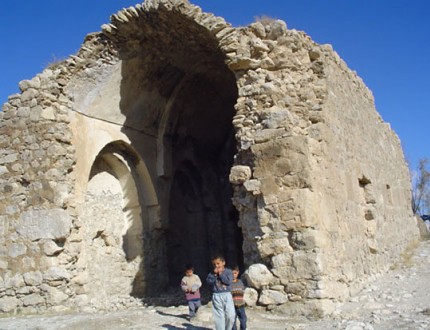
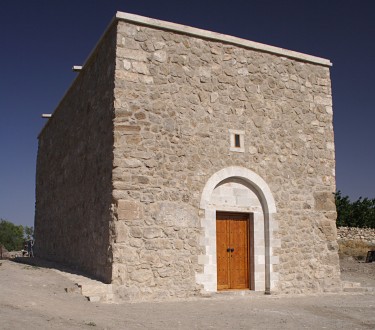
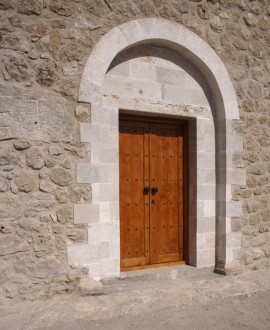
The restored church is a small structure with a rectangular exterior. It is constructed mostly from limestone fieldstones. The entrance to the church was on the west façade - however, almost the entire west wall had fallen before the reconstruction.
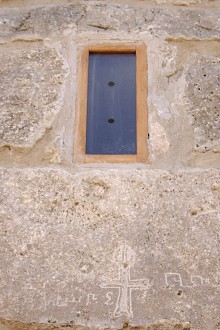
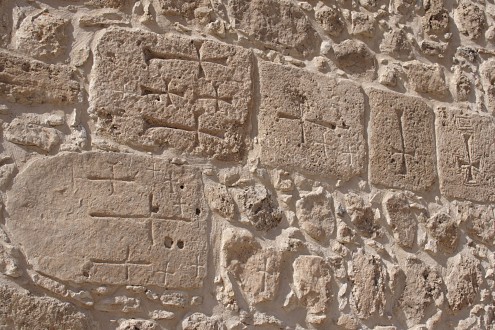
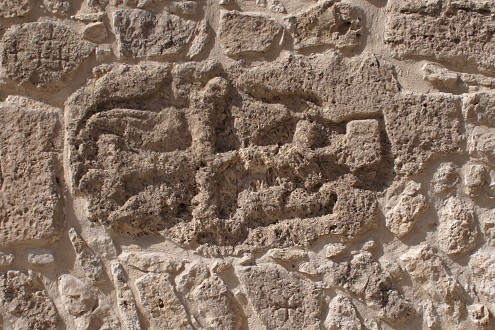
There are a number of stones bearing crosses that have been reused in its walls, in particular there is a row of them in its south wall. These reused stones were probably originally gravestones, but some of them could possibly have come from an older church that had stood on the site and were votive crosses carved on its walls. Most of them have very simple designs and appear to be from a late period, with the exception of a single, worn, "proper" khatchkar mounted sideways at the eastern end of the south façade.
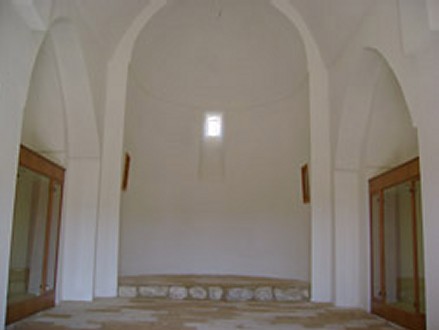
The interior of the church is barrel-vaulted and has a single nave ending in a semicircular apse. The usual chambers on each side of the apse are absent in this church. Pairs of blind arches resting on thick pilasters form deeply inset niches in the north and south interior walls. There is a tiny window in the apse and another in the reconstructed part of the west wall, above the doorway. The interior is now plastered and whitewashed.
The plainness and simplicity of its architecture, together with the crudity of the gravestones reused in its walls, point to a late date for this church's construction - perhaps as late as the 17th century.
The "restoration"
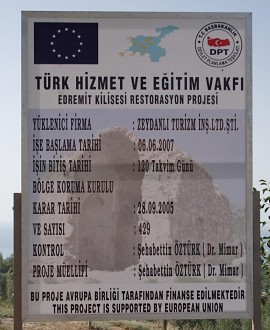
The Turkish firm Kaatalkaya undertook the rebuilding of the church. It is the same company responsible for the restoration of the church on Aghtamar island. The rebuilding officially started in October 2006 and ended in September 2007. The cost of the work was 185,000 euro, with the funding coming from the European Union's Eastern Anatolian Development Program.
The "restoration", like that of Aghtamar, is extremely severe and goes against accepted practices. The church now appears as a newly-built, bunker-like structure, devoid of any visual attractiveness and scrubbed-clean of any historical patina.
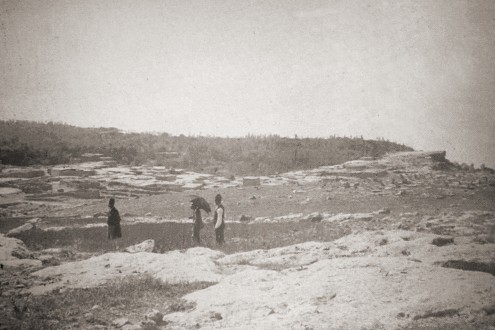
The church has been given an entirely new entrance, constructed from machine-cut limestone blocks without any attempt at giving them a hand finish. I do not know if the design of the new entrance was based on archaeological or documentary evidence – however, based on surviving examples, the opening is too wide, the lintel is far too thin, and the arch would normally be pointed for this period. The church has been given a flat roof - old photographs reveal it had a pitched roof [see the large version of photograph 1]. The creation of the flat roof has meant that the north and south walls have been raised well beyond their original heights and the gable has been lost, fundamentally altering the building's original appearance.
On each of the half-dozen or so visits I have made to the church, its entrance has been locked and admittance to the interior was not possible. Some sort of museum-like exhibit seems to have been planned for the interior, housed in display cases set into the niches in the north and south walls. Given the small size of the interior and the remoteness of the building this activity seems unlikely to succeed and, in the long-term, the church is all but certain to be permanently locked.
The purpose of this rebuilding needs to be seen in the context of the Aghtamar church's restoration, whose purpose was almost entirely political. The financing of the restoration by EU funds also indicates the political function of the Edremit church's rebuilding. It has been "restored" in order to silence critics claiming that the Aghtamar restoration was a one-off. The actual quality of the "restoration" and the historical value of the monument are unimportant to those responsible for this rebuilding. There are Armenian monuments in the Van region far more deserving of that 185,000 euro than this tiny and architecturally somewhat unimportant church. Moreover, the alleged "restoration" has destroyed the value of the building as a memorial object. Nothing is left to touch the emotions of a visitor; it can no longer be interacted with.
The cemetery site
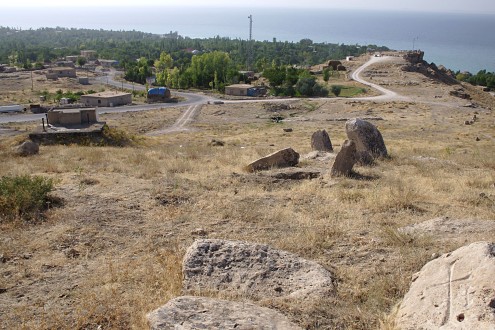
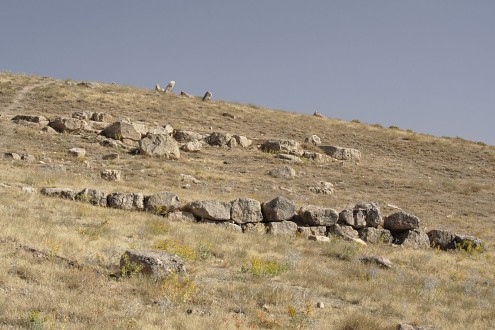
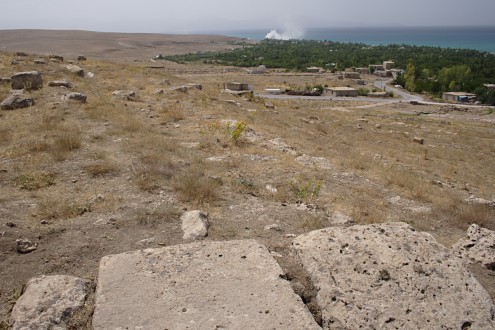
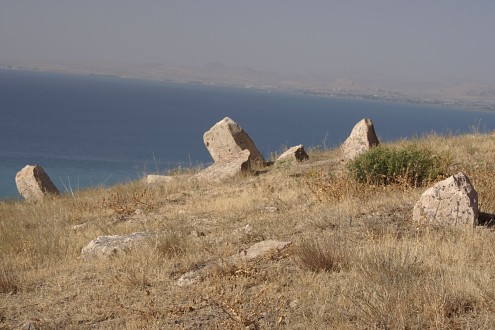
On the slopes of a hillside overlooking Edremit are the remains of a once-extensive medieval Armenian cemetery, as well as associated structures that suggest ritual uses. The hillside also contains the remains of several walls that may date from the Urartian period. The western and northern edges of the site have been disrupted by the cutting of a road that leads up to apartment-blocks on the hilltop. The eastern end of the site has vanished, having been quarried away. There are two disused lime kilns located below the eastern end of the site that were operating into the 1970s.
The Turkish archaeologist Oktay Belli claimed that this hillside site was part of the Urartian town of "Alniunu" [see note 4], and described it as consisting of two zones: a housing area and a stone-working area. "Alniunu" is known from a cuneiform inscription on a section of Urartian-period walls at Van castle that states "Sarduri, son of Lutipri, speaks thus: I brought these stones from the city of Alniunu and built this wall".
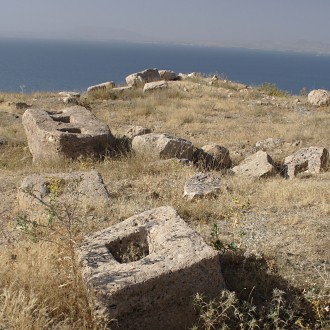
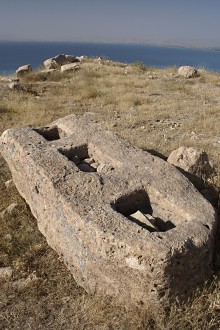
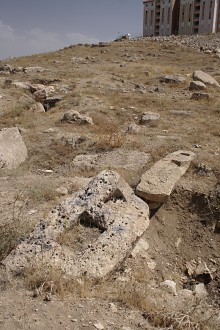
During my visits to the site I saw nothing that indicated ancient stone working having gone on there, but there are some walls that appear Urartian-like. Within Belli's "stone-working area" he identified several blocks with rectangular cavities that he described as being designed to hold Urartian steles. However, the entire supposed "stone-working area" is actually part of the Armenian cemetery site, and the stone blocks with cavities are just the in-situ bases of vanished khatchkar monuments.
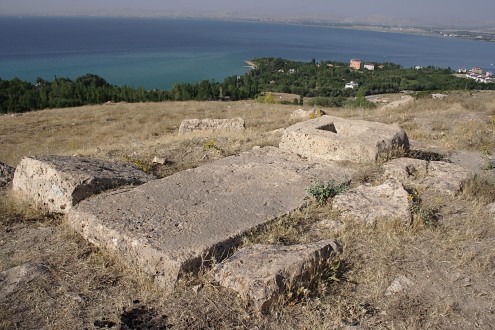
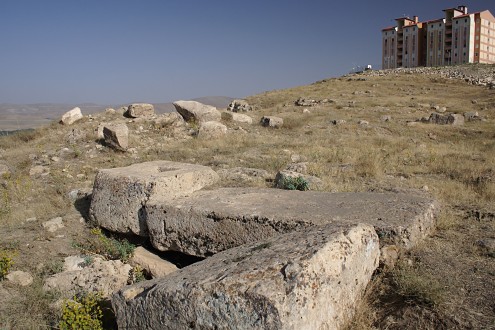
The blocks with the cavities are arranged in two long parallel rows that run in a north-south direction (i.e. the khatchkars would all have faced west, the normal orientation for khatchkars). There are at least twelve cavities in the western row: most of the blocks contain only one cavity, though one block has three. The eastern row is more disrupted but also contains at least one block with three cavities, and another with two. The rows run along the highest point of the cemetery site and any khatchkars located there would have been visible from a great distance - perhaps from as far away as Van. At the northern end of the western row is a khatchkar base that measures 1.25 metres wide by 0.95 metres deep, with a cavity that is 0.43m by 0.40m. In front of it is a grave covered by a massive limestone slab that is 1.25 metres wide and 2.55 metres long [see photographs 19 and 20]. West of this monumental grave is a level terrace-like area of uncertain extent that is paved with flat, irregularly shaped stones. There is a rectangular, similarly paved area immediately to the north of the grave, but at a marginally lower level. It extends out in a westerly direction and may possibly have been a ceremonial approach to the site. A little to the east of the monumental grave there may be what was a stepped ramp leading to the higher parts of the cemetery, but this part of the site is heavily disturbed.
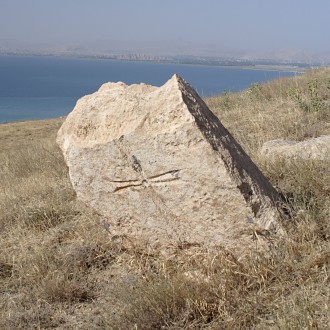
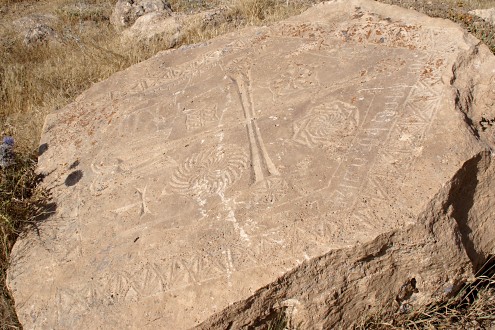
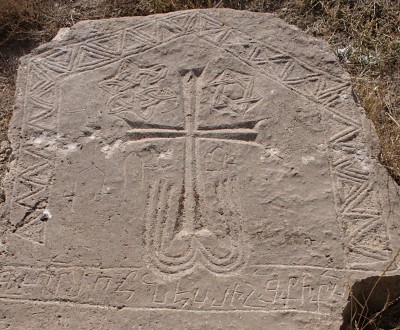
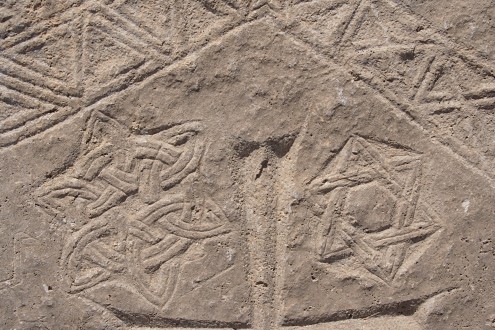
Some surviving Armenian gravestones are located in areas to the west and south of the two rows of khatchkar bases. These stones are probably from a much later period than the khatchkars rows. Many of them are now toppled and their graves are dug up by treasure hunters. Most of these gravestones bear nothing more than a plain cross. However, several stones have more ornate designs. The design of one [see photograph 24] consists of a cross within a decorated hexagonal frame, with an inscription in Armenian running along the inside of the top four sides of the hexagon. In each corner of the cross is a roundel-like motif - two of them depict eternity symbols. A second stone has a similar but smaller layout [see photographs 25 and 26].
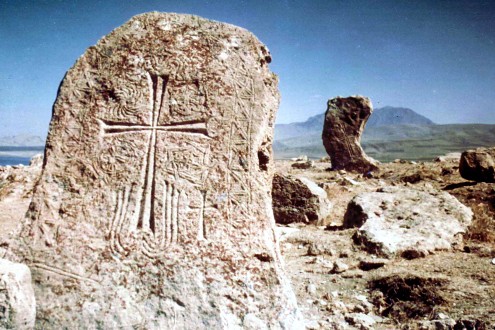
A photograph taken in 1973, found on Wikipedia, appears to depict the same graveyard. It shows a gravestone that no longer exists on the site but which has stylistic similarities to the above two stones [see photograph 27].
NOTES:
1. Raymond H. Kévorkian and Paul B. Paboujian, Les Arméniens dans l'Empire Ottoman à la veille du Génocide, p.535, Paris, 1992. The other population data is taken from H. F. B. Lynch, Armenia, Travels and Studies, volume two, p.121, London, 1901.
2. See for example dakp.gov.tr/haber_yorumla.php?haber_id=52&kat_id=1 and www.gayanpo.org/en/edremit-church-restoration-project.
3. Jean-Michel Thierry, Monuments arméniens du Vaspurakan, p.157, Paris, 1989.
4. Oktay Belli, Alniunu Kentinin ve Taş Atölyesinin Keşfi, in Anadolu Araştırmaları, volume 8, Istanbul, 1982. Available online at: www.iudergi.com/tr/index.php/anadolu/article/view/1469/.