THE HISTORY OF ANI:
THE RAPE OF ANI - THE TURKISH "RESTORATIONS"

|
The destruction along the City Walls
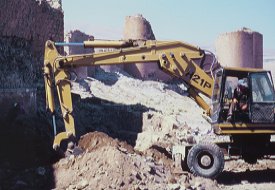
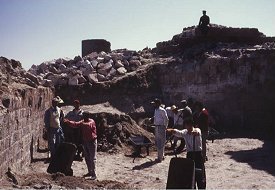
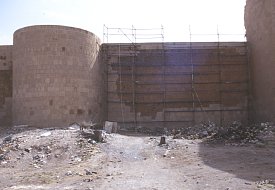
In 1995 extensive excavations were started along the length of the outer walls of the city, on both sides of the Lion Gate. The centuries of debris that had accumulated at the base of the walls was cleared away - in some parts this was over 3½ metres deep. This was not an attempt to make an archaeological excavation. No archaeologists were present and there was no inspection made of the removed material: it was simply dumped into tipper trucks and taken away. Most of the excavating was done using heavy machinery including bulldozers and shovel excavators.
This work was done as a prelude to a "restoration" of the walls, organised and paid for by the Turkish Ministry of Culture.
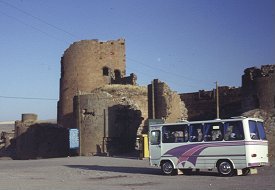
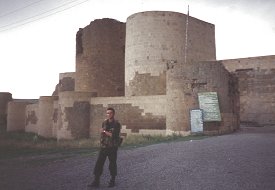
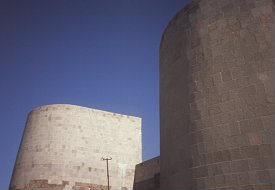
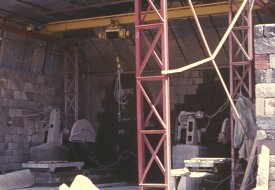
Restoration in Turkey often simply means destruction followed by a crude rebuilding - many historic monuments have been irreparably ruined by such "restorations" and the walls of Ani were not to be an exception, as these photographs reveal. In 1998 work on the walls had stopped after (it is said) some condemnation of the end results. However, local building contractors and politicians (who are often the same people) were making a great deal of money from the "restorations". In 1999 the process of destruction was resumed on an even bigger scale and the workers now had an on-site stone cutting factory. The walls of this factory were built entirely from stone looted from the ruins! These "restorations" have nothing to do with preserving the buildings or encouraging tourism, and their appalling results have nothing to do with just bad planning or a lack of knowledge of what should be done. There was never any valid archaeological reason to start the work because the work went against every established practice of modern archaeological conservation. The truth is that the surviving monuments at Ani are being exploited rather like an open-cast mine for the extraction of money. As long as Ani can be used by Ankara politicians as a conduit to distribute State money into the pockets of their local political and business allies in Kars (Professor Karamağaralı has reportedly called them a "Mafia") then the "restorations" will continue until everything in Ani is destroyed. Local opposition to the restorations is minimal, confined mostly to the few people in Kars who make a living from tourism. Within much of Turkish society there is a lack of understanding of the concept of an historic monument as understood elsewhere in the world. This must be partially connected to the unimportance given to historical truth in Turkey today. If no value is given to an accurate understanding of the past then objects related to that past have no value. Also, in Turkey, to criticise the powerful is a dangerous thing to do - it is too much to expect just for some old buildings that are not even Turkish. Outside pressure is also unlikely. From foreign historians and archaeologists the silence has been total. There is no change here - they have been silent for decades, fearful of even mentioning the word "Armenia" lest Turkish officials get to hear of it and deny them their precious research permits for Turkey. Foreign tourists to Ani mostly don't care, would not be in the position to know what has been lost (unless they had visited this website), and are too few in number to matter anyway. The restorations at Ani are politely ignored by most guidebooks (along with the similarly disastrous restorations of nearby places such as the Ishakpasha palace and Sumela monastery). Armenian groups are uninterested in doing anything practical. Many of these groups actually continue to present the lame old reasoning that nothing should be done towards pressuring the Turks on the issue of preserving Armenian monuments because it would only hasten the destruction of the remaining monuments. What has this pathetic policy of inactivity led to during the last few decades - has it saved a single building or has it just provided them with an easy excuse for doing nothing? |
|
|
Most simplified accounts of Ani say simply that the walls of Ani were built during 10th century, but the physical remains shows they were added to many times over the following centuries. The walls were thickened by additional masonry facings - in some places four different faces are revealed by subsequent damage (like the layers of an onion) and earlier crenellations are often "fossilised" within later masonry. The "restorations" have destroyed all of this historical evidence, including building inscriptions.
Also destroyed forever is the "patina" of history that these walls once proudly wore - their outlines softened after centuries of weathering; the marks of thousands of arrowheads inflicted in long forgotten sieges; the glow of the orange stone in the setting sun - all this is now gone. Ten years ago sheep grazed at the base of these walls, on grass covered slopes amid a tumble of fallen masonry - now there is nothing but a sterile wilderness of cement dust and stone chippings. |
| The destruction of the Merchant's Palace
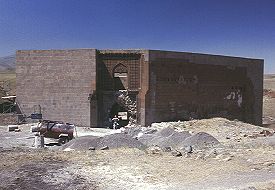
In 1999, a "restoration" began on the Merchant's Palace, again organised and paid for by the Turkish Ministry of Culture. The work continued into the following year.
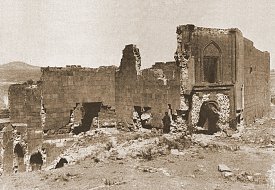
It ended in the near total destruction of this monument. There is now far more new stone than original stone in the palace, to the extent that the locals have nicknamed it "the prison" because of its appearance. There is no archaeological or documentary evidence to show that the walls as rebuilt originally looked like this, and the new building work resulted in the destruction of large sections of original masonry. Also destroyed was most of the evidence, in the form of beam holes, of the palace's timber upper floors and outbuildings. In the year 2000 a "restoration" started on the mosque of Minuchihr and the destructive restoration of the city walls had reached the Kars Gate. In 2001 the "restoration" of the city walls was extended easward to the Chequerboard Gate. In 2002 the "restoration" moved on to the walls to the east and south of that gate. |
|
|
|
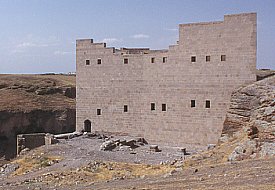 10. Nothing that can be seen here is older that 1999!
|
|
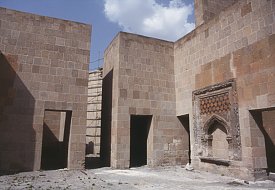 11. Try to spot any original stonework inside!
|
|
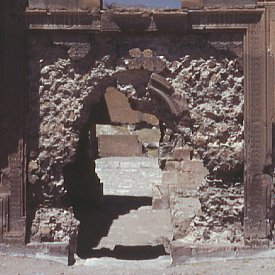
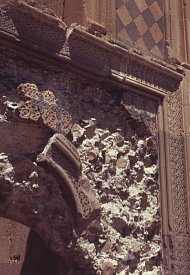 14. The tiles before the restoration |
|
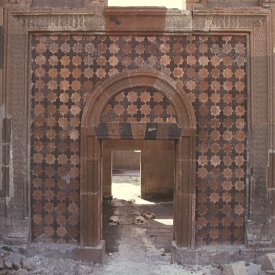
Take a careful look at what the "restoration" has done to the palace's entrance. All of the original decorative tiles have been removed. A few have been put back, but they are now in different positions! The tile pattern has been altered: it has moved downwards by half a star. Half of the surviving block in the doorway arch has been hacked away, and a large section of the top of the rectangular frame has also vanished.
|
|
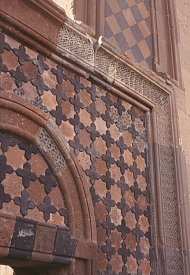 15. The tiles after the restoration |
|
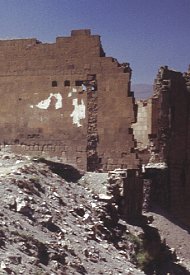 16. Question - what happens when you pile a lot of new stone onto old and fragile foundations? |
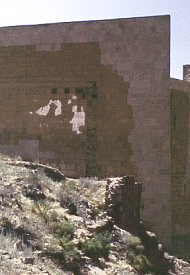 17. Answer - the whole structure gets heavier, and heavier, and weaker, and weaker... |
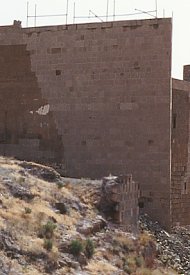 18. ...until everything collapses - which means you can get more money for rebuilding it all again! |
|
...back to the previous history page, "Ani: Recent History". |